When I was fifteen years old, my father found out he had Stage IV lung cancer. He’d been wheezing on our weekly walks to his mom’s place for a while and coughing more than usual, so we all knew something was wrong, just not how wrong it was about to get. He was sick, then very sick, then even sicker, until finally there was no other way to describe it: he was dying. And then he was dead. His illness jump-started my adulthood, and his death cemented it. There was no going back. I was an Adult, a Grownup, capital A, capital G.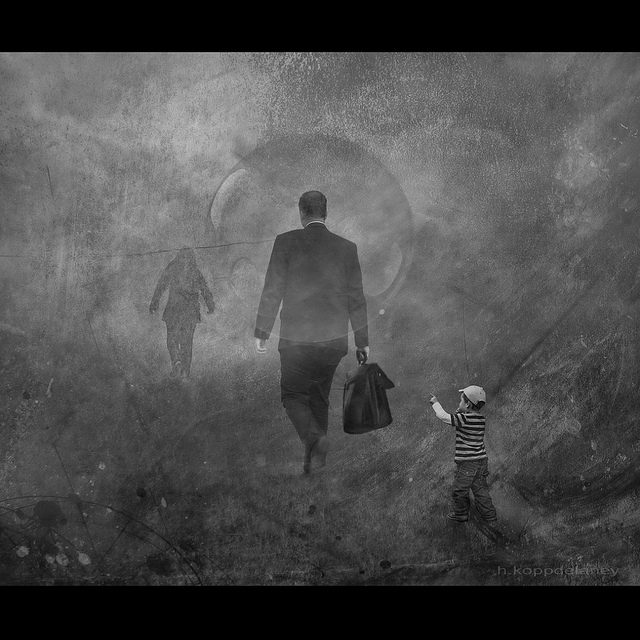
When I was fifteen years old, my father found out he had Stage IV lung cancer. He’d been wheezing on our weekly walks to his mom’s place for a while and coughing more than usual, so we all knew something was wrong, just not how wrong it was about to get. He was sick, then very sick, then even sicker, until finally there was no other way to describe it: he was dying. And then he was dead. His illness jump-started my adulthood, and his death cemented it. There was no going back. I was an Adult, a Grownup, capital A, capital G.
Fatherhood is an interesting societal role. We have so many ideas and assumptions about what a father should be, and these, of course, have changed over the centuries. According to the extremely nifty Online Etymology Dictionary, the Old English, fæder, means “he who begets a child, nearest male ancestor;” or “any lineal male ancestor; the Supreme Being.” By late Middle English, it meant “one who exercises parental care over another.” The word “dad” is actually much older and almost universal (in a variety of forms) because of the common syllables “da-da” that babies utter when learning to talk.
Fathers are not supreme beings. And many of them do not exercise parental care over another. I am not a historian, and I cannot tell you exactly when the modern Western idea of fatherhood was created, though I do know that Freud had a lot to do with it. What I do know is that the concept is still in flux. For many Americans, fathers don’t exist: they up and left, they’re in jail, they’re service-members who rarely see their families, they work long hours in corporate positons and leave their children with a stay-at-home-parent or hired help. Many mothers fit these same descriptions and indeed there is a rise in single father households, though three quarters of single-parent households are headed by single moms. We have this notion that mothers are automatically closer to their children because of the biological connection between womb and baby. This not only assumes a whole lot about what a woman is (not all women are able to give birth, not all women want to), but also throws light on why we seem to accept fathers as the more transitory beings. They’re the ones allowed to be gone, because their purely biological role ends after providing the little swimmer that fertilized the egg that made the baby.
I am lucky; I had a father in my life for sixteen years. I am unlucky; he never knew me as a grown woman. My sixteenth birthday was spent at his hospital bedside. He died a few months later. My father was the kind of guy who, had he survived to see my eighteenth birthday, would have offered me a joint to share with him. We would have gone out for beers. We would have had long walks on the beach in Israel and long Skype conversations once I’d gone to college and we’d talk about relationships I was in, and he’d tell me stories about his various exes, some lovely and interesting, some extremely manipulative (one threatened to commit suicide when he broke up with her). Instead, by my eighteenth birthday I was dating his best friend’s son and developing an eating disorder.
I have also developed a strange discomfort around fathers in general. Not regarding strangers, mind you. Dads on the subway with their teenage kids, dads in grocery stores humoring their children’s wish for sugary cereal, dads taking campus tours with their college-bound kids – all of these warm my heart, make me miss my father, make me believe in daddyhood. It is my friends’ fathers, my acquaintances’ dads, and older men who are my mentors and friends (and who have children), around whom I feel uncomfortable. Not because of anything they do – this is an important point that I want to stress. These men have not been inappropriate with me. The fear, the discomfort, lies in myself: am I being inappropriate with them? The thought process goes something like this:
Do they think I’m flirting? Do they see me as a sexual being, as an adult, a grownup with experience? Are my breasts too exposed? Are my pants too tight? Am I appropriately asexual when I talk to them? Do they fantasize about younger women? Wait, no, don’t go there. But wait, do, because what if they do something? How would I handle it? Would I tell my friend/significant other that something weird happened? Would I ignore it? What if it’s that teacher I’ve always had a crush on because of his intellect? Would I want him to cheat on his wife? Wouldn’t I feel terrible? Can he even see his students that way? Why am I thinking this? What’s wrong with me?

I am not unique in this. I have talked to other women around my age and they feel similar discomfort. Maybe this is the equivalent of the way teenage boys fall in lust with their friend’s mothers or their female teachers or their parents’ friends. Do teenage boys actually do this? I don’t know. I’m basing this knowledge off of movies like The Graduate and Superbad and television shows like Buffy the Vampire Slayer (and many, many others).
Unfortunately, I think that my own neuroses about fathers has less to do with my dad being very much dead, and much more to do with the way older men are portrayed in pop culture, literature, and psychology. According to Freud, of course, I was and am in love with my father and because he died, I now seek to find him elsewhere. Except that I haven’t dated older men. I haven’t had random sex with older men. (I sometimes wish I had, but mostly just for the resulting story.)
Fathers are sexual beings, of course. The very nature of fatherhood traditionally involves the act of sex. But there is supposed to be, at least according to Western social mores, a detachment between father and daughter. That’s one of the reasons Lolita, by Vladimir Nabokov, is so shocking and upsetting. Not only does Humbert Humbert truly believe that Lolita loves him and that she is the instigator in their relationship, but he also marries her mother, becoming an even more screwed up version of a father figure. A more recent and equally disturbing example of this kind of story is American Beauty, the film starring Kevin Spacey as a father who falls in love (or lust? Open to interpretation, I suppose) with his daughter’s friend. Another example is our fascination with incestuous father-daughter relationships, as exemplified by Precious, the film based on the novel Push by author Sapphire. In the film Eve’s Bayou, the character playing a philandering father begins to ardently kiss his older daughter, to their mutual horror. We find this fascinating, taboo and exciting even while regarding it as somehow filthy and degrading.
Older men in general are often seen as sexual in pop culture. For one thing, leading men in Hollywood are allowed to be much older than leading women. May/December romances are common in movies and television shows because men look dashing in their grays and women look best when their breasts are still perky and they don’t have wrinkles. While women in Hollywood are fighting this, and there are some “token” older women who continue to get roles (Vanessa Redgrave, Dame Judy Dench, and several other typecast actresses who always seem to play the annoying mother to someone or other). But older men continue to flaunt their sexuality well into their later years, a la Woody Allen, who even as he aged, continued to pair himself off with younger actresses. Hugh Grant keeps getting paired with younger actresses as well.

The music and literary scenes are similar: Paul McCartney still has a huge following, so did Lou Reed. Jonathan Franzen may be hated by some but is also beloved by many, and John Irving as well. Similarly with Stephen King. Their author photos tend to be much larger than, say, Hillary Mantel’s or P. D. James’s.
Older men are simply more appealing than older women. That is what society has taught us. The question then becomes, how do young women like myself learn to feel comfortable around them – and fathers in particular – without changing our behaviors and becoming meek little girls?
The only solution I have found so far is to ignore the discomfort. It is usually not the older man or father’s fault (unless, of course, he IS making any sexual comments or staring) but rather the larger role the patriarchal notions have been embedded in me. I call my friends’ fathers by their first names and we chat like old friends, and even when I wear a tank top with a lowish neckline (which is basically all I ever wear because I am a sweater and t-shirts don’t work for me) I try to remember that my body in itself is not an invitation to sexuality. I am friends with several older men and try to remember that not all men have a one track mind and that my fear is part of the same power that the patriarchal society has on me and that I am lucky enough to be able to put aside that fear when I choose to.
And I do. Am I more open to danger? Possibly. But I refuse to live in a world in which I have to be scared of every father or older man I know, in which I cannot relate to people as people rather than as their genders. It takes a great deal of effort, but I make it work.
Thank you to everyone at Beacon who supported and funded this article.
Images: Flicker (1) (2) (3)
 Photo: Ilana Masad

 Slightly Ignorant