Review: LEAVING THE ATOCHA STATION, by Ben Lerner

My boyfriend, whom I have converted back into being a reader, bought both of Ben Lerner’s books at the Brooklyn Book Fair a few weeks ago. He read them both in a matter of days, and recommended them highly to me.

I was more than happy to take his recommendation, especially as the name Ben Lerner has been circling around the online literary scene for a while. I’d seen his name all over the various sites I frequent and I thought it would be nice indeed to read something contemporary and hip. I was excited, looking forward to it, and expecting to like it.

Ben Lerner can certainly write. Before writing this novel, his first, he’d published several poetry collections according to his bio. Indeed, Leaving the Atocha Station seems to be a fictionalized version of Lerner’s own experience as a Fulbright Scholar in Spain. The book’s main character and narrator, Adam Gordon, is also a poet, is also in Spain on an unnamed research-based fellowship, is also a graduate of a university on Rhode Island (i.e. Brown). Possibly also like Lerner – but here I’m speculating – Adam Gordon thinks he’s basically a fraud.

Adam Gordon is also an incredibly unreliably narrator, which could be interesting in theory, but ends up being profoundly dull. I had sympathy for him, to an extent – he is depressed and medicated for it, his self esteem is buried under the floorboards, he seems to be acting out his life out rather than living it – but I also found him extremely obnoxious. He treads the same ground that so many have gone over before, and is leaving no new footprints in his wake.

From Henry James to Henry Miller to Earnest Hemingway, the insecure white privileged male living abroad has been explored ad nauseam. James was an innovator in his deep exploration of our minds and moods, and Miller, much as I hate him, at least managed to be interestingly offensive in his obsession with douching prostitutes and lecherous men. Hemingway I personally regard as a writer who misunderstood himself and perpetuated his personal myth to the point where he is believed to be more of a misogynist than Miller (c’est impossible!). The thing about Lerner is that he’s none of these, and nor is Adam Gordon. There is a wrap-around kind of logic to his character – Gordon’s fear of being a real poet, a real artist, is curbed by his own belief that he is a fraud, which as a result makes him even more of a real poet, and a modest one at that. The irony underlying every word he utters is mirrored in the prose itself. And while I do live in Manhattan and do enjoy small and trendy coffee shops, I have also grown truly sick of the hipster urge to take irony to its outer limits and beyond.

The indulgent, ironic self-hatred that Gordon is constantly experiencing becomes exhausting and dull. He is both detached from and profoundly inside of himself, and even in his most miserable moments, there is a self-congratulatory tone, as if he’s actually quite enjoying be so tortured and complicated.

Let me stress – it’s not that Lerner isn’t a good writer. He very clearly is. Some of his shortest, simplest sentences convey a vast amount of emotional information:

Without texture, time passed.

Or:

The cities were polluted with light, the world warming.The seas were rising. The seas were closing over future readers.

Ben Lerner is clearly a poet. Maybe he has come to terms with that by now and maybe not. My question, as a reader, is why did he need to transmit his own learning curve in this way? Seeing him lust after or sleep with all the women he knows, smoke weed and drink to excess every night, and not take his own work seriously even while everyone else does – it all gets pretty boring and repetitive. Not to mention a bit infuriating. Adam Gordon gets everything, apparently without trying. Is this the lie we’re supposed to recognize? Is he, in fact, making an immense effort when living in Spain on his fellowship’s funds even while not doing the research he went there to do? Or are his anxiety and depression enough to make his laziness understandable, admirable even?

Most writers will tell you that writing is hard work. Lerner’s return to the whimsy of effortless poesy coupled with obsessive anxiety and self-scrutiny are not particularly fetching, mostly because they’re so clinical and automatic. There is so little feeling in the book – except that of Adam for himself – that it ends up seeming like a grand experiment in narcissistic (and ironic) self-hatred.

Maybe it’s just that I went to college with people like Ben Lerner and that I experience them still, living in New York. Maybe this book hits too close to home in the need for validation that is hiding behind its fake humility. Whatever the reason, the result is the same. To my mind, Lerner’s sentences are beautiful, his prose cleanly rendered, but his impact on me was close to nil.
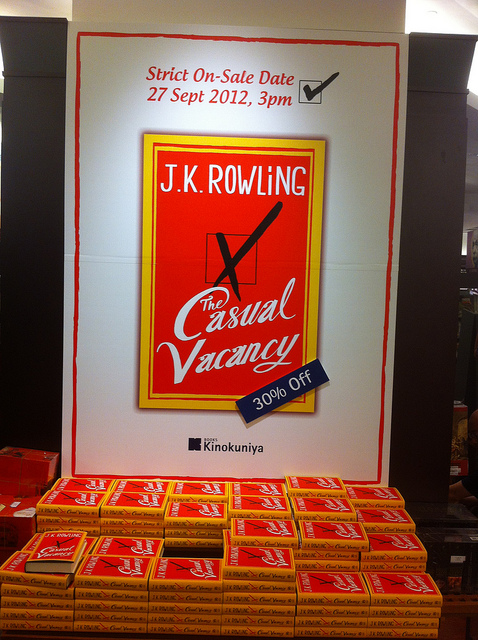
Vacancy Filled

PHOTO / Marc van der Chijs

PHOTO / Marc van der Chijs

If it were possible to approach the subject of JK Rowling without discussing her previous work, I would do so. To mention the name “Harry Potter” is to bring up an entire slew of associations, whether positive, negative, or bored-to-tears indifferent. As a disclaimer, I must admit that I am a fan – the kind who always appreciated Rowling’s works on its own merits, first and foremost, and only then pinned a Hufflepuff badge on my backpack. I was, and still am, a devotee of the seven-book series, but I dislike the films, and stay away from the vast and – to me – frightening world of online fan-fiction.

It is as a writer rather than a celebrity that Rowling became a published author, and she wrote the Harry Potter books in a particular style. Her voice has always been uniquely hers, from the very first particularly, peculiarly, English sentence of the first book – “Mr and Mrs Dursley, of number four, Privet Drive, were proud to say that they were perfectly normal, thank you very much.”

The Casual Vacancy, JK Rowling’s first novel since she completed the Harry Potter series and its various offshoots, was promoted, disappointingly, as if it was an extension of the HP universe. The books filled the entire wall of shelves behind the Waterstones cash registers here in Oxford, the novel was promoted and given lengthy reviews in major magazines and newspapers, and it was generally treated as if it was going to be another merchandisable opportunity for the likes of Universal Studios and Sony (who each, respectively, runs the Wizarding World of Harry Potter in Florida, USA and the online virtual book-world Pottermore). While the reviews were very mixed, running the gamut from glowing to scathing, the book was generally treated as the work of celebrity rather than what it was: a first literary novel by an author who was (as she admitted to being) both proud of her book and wary of its reception.

Rowling has now proven that her voice is consistent. The language in the novel is simple and straightforward, while blindsiding the reader here and there with a brilliant observation or description that is shocking in its apparent clarity. Her vivid English-isms aren’t lost either: each section of the book opens with a quaint quote from a 17th century book of parish-council rules.

What is most amazing of all, however, is Rowling’s heretofore hidden talent for writing some truly despicable real-world characters. It is wonderful, exhilarating and endearing. A discussion that is still common in the writing and publishing world is the difference between men and women authors and their aptitude in writing unsympathetic characters. Women are often said to write too “nicely”, resulting in books of lesser merit or critical acclaim. Rowling strikes a blow for women authors everywhere in not softening her novel just because she is known also to be a children’s author (although, as an aside, anyone who claims that the Harry Potter books are for children may want to take a second look at them).

The Casual Vacancy’s characters are unflinchingly, unapologetically, and unabashedly nasty, one after another: Samantha, a middle-aged woman who ends up snogging a fifteen-year old boy while drunk at a party; Howard, the morbidly obese town bully who touches Samantha’s ass every time he sees her, though she’s married to his son; Simon, who buys stolen goods and hits his children and his wife but still thinks he’s one hell of a swell guy; Fats, a middle-class teenager who believes that it’s more ‘real’ to sleep with a girl from the slums he doesn’t actually like, because having a tough life is cool and enviable. Listing the characters like this makes them sound almost ridiculous, but Rowling’s superiority as an author is that each character is absolutely believable and has a motive and reason for acting as he or she does. Though the reader may end up hating them, she also ends up understanding and empathizing with them.

Rowling’s powerful novel deals with big issues – from ambition, loneliness and family to race, addiction and poverty – but it doesn’t shove any moral notions down the reader’s throat and it doesn’t offer idealistic, impossible, solutions. It portrays a slice of reality between its two covers, a story worth telling and worth reading, and, yes, (for those for whom this is the main the draw) it gives the reader the bizarre pleasure of seeing the word “fuck” written many times by the same woman who invented the snitch, butterbeer, and Dobby the house-elf.

Book Review: “The House of Mirth” by Edith Wharton

Hard as it is to picture New York City’s 5th Avenue lined with houses, it is much more difficult to really grasp the way American high-class society functioned a mere century ago. When I read Jane Austen’s female characters’ trials and tribulations, I remember that she and they are some two hundred years removed from my world of tank-tops, flip-flops, cougars and boy-toys. The names of pastoral English counties and villages, if they still exist, echo in my ears as from long in the past.

Wharton’s Lily Bart, however, inhabits a world that includes Central Park, 59th Street, Madison Avenue and Long Island. These familiar names resonated within me as I read of Mr. Trenor’s crude flirtation with and near-rape of poor Lily, and reminded me that a hundred years is not so very long. It chills me to think that the same streets I walked just a couple of weeks ago used to be inhabited by a society that excluded women like Lily Bart if they were whispered about and tainted by the slanderous tongues of their so-called ‘friends.’

Lily is not an innocent by any mean, but to be fair, she is painfully honest with herself. She’s manipulative, shallow, wasteful and sometimes tactless, and knows herself to be ornamental rather than useful. But she’s the heroine of this beautiful book, and despite her many shortcomings – or maybe because of them – I loved her from the first chapter. Her fall from grace is described gradually, through a series of events that are seen by her social-circle as indicative of her ‘fastness.’ In truth, she’s not fast at all – she’s rather picky, and though she intends to marry someone rich enough to support her gambling habit as well as her wardrobe, she never manages to follow through on these base instincts.

Wharton’s language is subtle, but any reader attuned to the nature of witty word play that floods novels of a certain era will be able to pick up on the truth behind the niceties: the couple having marital difficulties are clearly cheating on each other, Mr. Trenor is asking for physical and not monetary repayment of Lily’s debt, Gerty Farish represents what Lily might have been under different circumstances. So much of this is between the lines, however, that a reader trying to ignore the hints will lose a lot of what is being conveyed.

Perhaps the most interesting feature of the book is the way Lily’s change of outlook affected my own opinions. The odious Mr. Rosedale and the gossiping Mrs. Fisher became my favorite characters by the closing chapter – their knack of speaking the blunt truth rather than beating around the bush was refreshing in Lily’s world of careful conversation and venomous whispers. Wharton’s ability to change a reader’s mind is to be admired.

I highly recommend The House of Mirth, although I daresay you won’t find much to laugh at in its pages.