Things He Missed in Eight Years

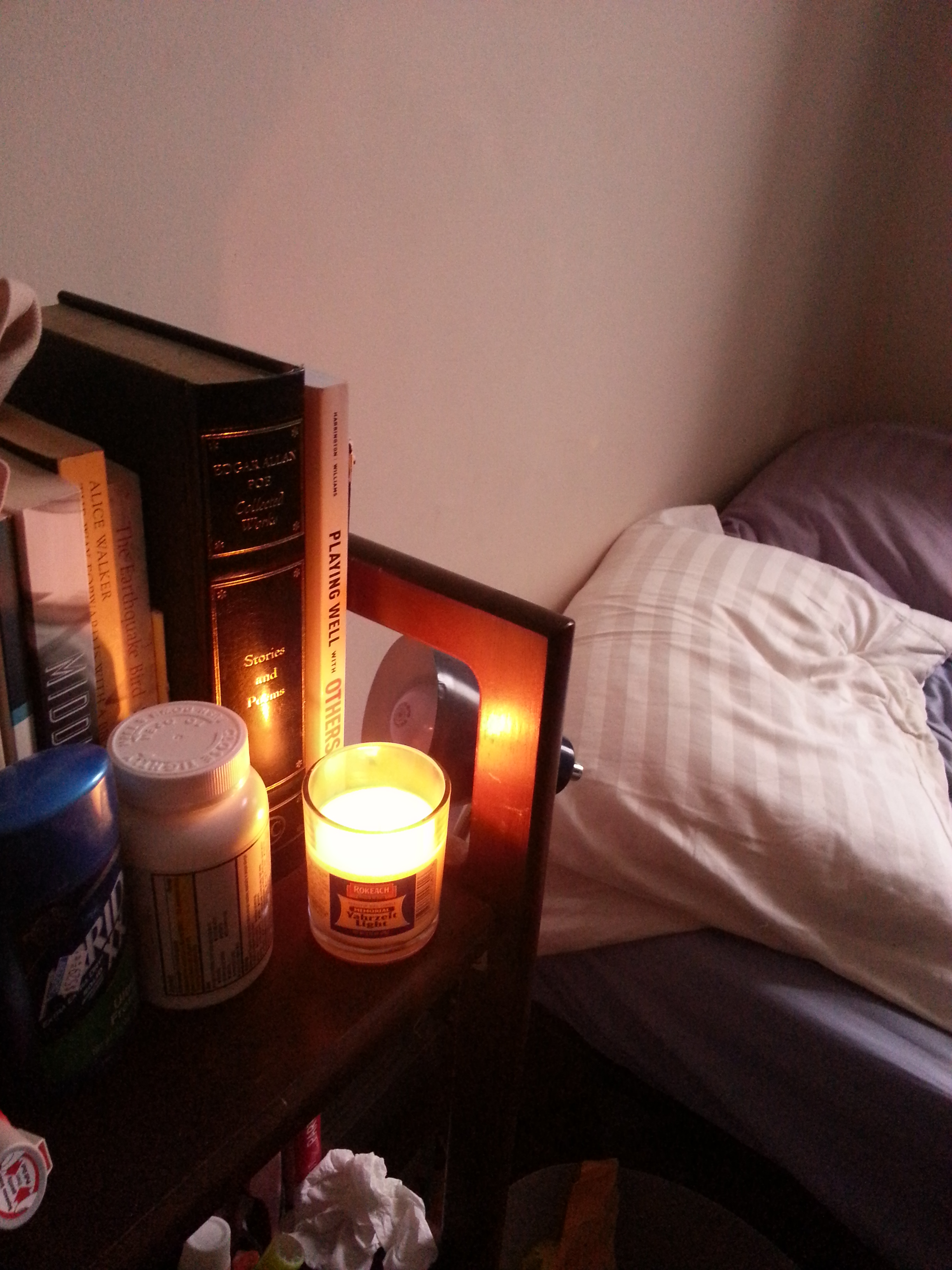
IMG_20141106_084227Losing my virginity.

Falling in love with his best friend’s son.
Graduating high school.
Getting a big girl job.
Anorexia.
His son’s graduation.
Going to college.
Anorexia again.

Getting my heart broken,
though not for the first time.
Going to college
(for real this time).
College, college, acting, writing,
friends.
Coming out as bi.
My second girlfriend.
Oxford.
First publication. Second.
Literary award (shared).

His son’s ambitions,
to PhD and beyond.
His love, his happiness,
his cats.
His engagement.

Moving to New York.
Looking for work.
Writing. Writing.
Falling in love.
More cats.

His wife’s decision to move.

His retirement.

Trade In

When I walked into the bar with you, it was a normal night. We’d made ourselves pasta with peppers and onions and a brownish sauce that you invented and eaten it in front of the TV with the latest episode of that crime show you like so much. The funny one. We took showers, separately, and I cleaned your hair out of the drain and didn’t say anything to you about it. I wasn’t being passive aggressive, I was just loving you. It was one of the ways I loved you, without you knowing about it. When Nick called us and asked us to come to the bar he liked picking up women at, we looked at our watches and said sure, why not, it wasn’t even nine and we hadn’t gone out all week.
When we walked into the bar, Nick was already in full swing, a brunette with a great shirt – it was open in the back, and her spine was the kind that sinks in rather than puckers out, which I’ve always found attractive. I pulled on your arm, and asked if we should sit elsewhere. You looked down at me, and I loved you for being tall, and you laughed and said no, we can join.
Nick introduced us to the woman, Gen, with a G, like Gen-X or Y. She said this first thing, and you and I squeezed hands, each of us knowing that the other was thinking about the conversation we’d had sometime recently about how hilarious we thought it was when people insisted, upon first meeting anyone, on explaining how unique their name was because it was spelled differently.
Gen and Nick already seemed like old friends. For all I know they were. I haven’t seen either of them since that night, so I never got a chance to ask. She kept looking at you though, and then at Nick, and then at you. Whenever I tried to ask her anything, she gave me monosyllabic answers.
We drank a lot. Two beers each, and then we got to doing shots because Gen kept ordering them from the waitress. After three rounds, I noticed that only three shots were appearing. None for me, apparently. I didn’t say anything because I wanted to be sober enough to take you home.
The music got louder as the night approached eleven. I was bored. I could barely hear what anyone was saying, and the lights were getting dimmer. I was sleepy. I heard Nick yell, enunciating as if to someone who didn’t hear him the first time, that you and I were “cool.” I didn’t know what he meant, until I did. Gen started being nicer to me, touching my hand across the table and meeting my eyes and then flicking her own towards you. She started buying me shots again too.
Around midnight, I finally dragged you out, Nick and Gen trailing us, and we all got into the same cab. Nick gave the driver his address first, which pissed me off, but when you got off there too, and I sat in the cab, one foot out on the street, and one in, I began to know something was off. Your hand was on Gen’s hip. Had that been happening in the cab? I was in the back with you and her, Nick was in the front. You held your hand out to me and gave me that smile, the one you give me when I come out of the shower wrapped in a towel, and I shook my head.
You beckoned, with your head, with your whole body, and I said no. Gen put her hand in your pocket. I put my foot back in the cab. Nick was waiting by his front door, holding it open for you and her. He was smoking and spitting like he always does. I shut the door of the cab and asked the driver to take me home.
I didn’t have any money. He was angry and yelled at me. I gave him my number and full name and told him to call me tomorrow and I’d give him my credit card info.
When I got inside, nothing looked like you anymore. The hair in the wastebasket in the bathroom made me gag, or maybe it was the alcohol, and when I leaned over the toilet and threw up, again and again until there was nothing left in my stomach but acid and bile, I felt only a shadow of you behind me, an absence, where you should have been, waiting with a glass of water and a toothbrush, telling me sip, brush, come to bed.

Pre-Trial


They say it’s passion that gets you here but I don’t believe that. It’s not passion. It’s greed.

At least, it was for me.

When I was a kid, my sister wanted to be an actress. She wanted to be as big as Marilyn Monroe and Nicole Kidman. I don’t know why she focused on those two. They had nothing to do with one another. They were both hot, sure, but she was too young to know that. I think. Who knows what girls learn. They say they mature faster than boys, and I guess I can say that’s true enough.

Anyway, in college, I had this girlfriend. The first one I’d ever had. And she wanted to make big bucks. I mean, big. She was going straight to law school and from there to some big corporation that she’d been interning with since she was seventeen. It was scary, man. It was like, she knew what she wanted to do and she was doing anything and everything she could to get there. It was damn sexy, let me tell you that, but she was kind of impatient with me. She liked me well enough, I guess, but she didn’t like the way I bummed around.

She didn’t like that I didn’t have goals. That was the main thing. That was what broke us up.

What happened was on our three year anniversary she dumped me. Right there on the quad, on our way home from the restaurant, the only real restaurant in our middle-of-nowhere college town. I told my buddies and my mom that I knew something was off the whole evening but that’s not true. In hindsight, I started to wonder whether there had been signs, so I said there were, because I looked like enough of a chump already, but there weren’t. She hadn’t said anything to make me suspect.

Even when she dumped me she said she loved me. I hate that. You can’t love someone and then tell them you shouldn’t be together. It just doesn’t make any sense.

Graduation was pretty soon too, and she knew I had big exams coming up before then but I guess so did she, so I can’t really complain about that so much.

I didn’t know what to do with myself after. I almost failed a bunch of tests. And after college, man, I was pathetic. I lived at home with my mom and my bum brothers and just watched Adventure Time and smoked weed all day. For like months.

Until I saw that she’d updated her Facebook status. She had a new boyfriend. Some dude with a LinkedIn resume about a mile long. He was older, too, like almost thirty. That’s when I had to change things.

So I started looking for where I could go that would make her find out about me and I’d always done a little bit of coding on the side, you know, just for fun really, but I suddenly realized how much people wanted to hire people like me. So I got a job by lying on my resume about how much I knew and I learned on the fly. It meant lots of all-nighters at the office, but that was fine, it was one of those cool ones where they had beer on tap and coffee machines everywhere.

Now here I am, ten years later, and she’s suing me. Believe that? Suing me. Okay, not her, a client of hers, but whatever, it’s damn near enough to be the same thing. Her clients are competitors of the company I founded and they’re saying we stole a bunch of ideas from them.

So what if I did? Everyone steals from everyone these days. And I’m rich enough that I can afford the best damned tech lawyer out there. Which happens to be her, actually, but I can’t hire her so I hired some guy who used to work for her.

The guys that work for me keep asking me why I’m not more nervous. The trial starts tomorrow and all, they tell me, and even though they’re loyal and they think I’m the bomb and all, they’re scared they’re going to lose their jobs real soon. A couple people have quit on me already.

So here I am, telling you now, this is why I’m not nervous. Because I get to see her again tomorrow, for the first time in over ten years. And I know she’s divorced. And I have a plan.

Earth’s End

The rabbits are soaring in the sky tonight. The owls are prowling below ground. The topsy turvy magic has won out and we are trapped here.
There are stairs going sideways in the air instead of up or down. There are trees growing downwards, their roots thrust in the air like expressive javelins. There is a moon shining in the sky, but it is bright green and the sky itself is red.
Red is for blood. For fear. For the end of the world.

It all started several years ago, but it was so slow that none of us knew what was happening. How could we? How could we predict the changes that were to come? Seven years ago we still thought that rats were mute creatures that had no language like ours, we thought that we were alone in the universe, we thought we were the most intelligent species there is.

Now we know the truth, which is that we don’t know anything. It’s a start, at least. It’s something.

The elders say we need to be patient. That things will sort themselves out. They talk about the second coming of Christ, about the return of the Buddha, about Khali raising an army for us. About the God of the Old Testament throwing fire and spreading brimstone around the forests that have turned on us. They tell us stories at night, by the light of our generator-fed lamps. We listen and eat out of old cans and plastic bags of chips. We rip apart packages of desserts that last forever and discover they are rotting inside. Even the laws of chemistry and physics do not apply anymore.

At the beginning, we remember, we were told that this wasn’t the end of the world. It was an anomaly, so some said. Or a discovery. A momentous occasion. The landing of the first ship on earth was meant to excite us. The television news anchors were spinning it with smiles plastered on their faces. The online journals and newspapers and blogs were split about evenly between Armageddon-fearing moronic pieces of drivel and excited scientists spreading their zeal for knowledge.

Some of us, it is important to say, wanted to remain ignorant. This seems unbelievable to some, or at least it did, it used to. Now people know that ignorance really is bliss. When reality goes nightmarish on you, all you want to do is shut your eyes and go back to sleep. We understand the wisdom of that now.

The landing, the first one, was relatively innocuous. The ship was empty and we had no visitors, but there was a host of communications. It took a long time for the people at NASA to decipher all of it. The rumor was that they’d actually needed to hire some of the conspiracy theory nuts we used to watch in online videos, because the nuts knew more than the NASA people. They’d studied more about this stuff, they’d trained themselves to spot patterns and connections that real scientists simply didn’t believe in.

Once we’d accepted that changes were coming, when we knew that another ship was coming, that we were going to have to figure out diplomacy with creatures besides humans really fast – that was our golden age. Suddenly humanity bonded together and wars that had been raging for years, even if subliminally, were put aside. Occupations were either accepted by the occupied or abandoned by the occupiers. There was something bigger than all of us happening and if we didn’t adapt to it we would all, collectively, be left behind.

Then, too, there was that idea that is prevalent in every small community – which is, after all, what we’d learned we were. Just a small neighborhood, maybe the equivalent of a block or so of the universe, which was far more orderly than we had always assumed. No, it was our own minds that were in chaos, not the laws of the universe. The idea, though, that became overwhelmingly clear was that we didn’t want to be ashamed of ourselves. We wanted to be able to hold our heads up with pride, to hold ourselves together, not as races or nationalities or peoples, but as one species regardless of our differences. We knew that it was important to bond together.

It was as if we knew that everything was going to go wrong. Almost as if we could feel the crazy mounting up against us, the rules breaking, gravity shifting beneath us, the laws of reality bending. We were right. But bonding didn’t help us at all. Nothing could have. We were, we are, doomed.

Staying

We cling together like droplets of water, crawling up or down glass in order to fuse with similar molecules. We isolate ourselves and shut our eyes to what happens outside our safe haven. We are loyal to one another and to no one else.

When we climbed onto rooftops as children, we saw the reason behind our elders’ warnings not to go up there. The view beyond our narrow streets and teetering buildings was grim. If our own children’s expressions are anything like our own were, the world outside our walls has not improved.

When the rare outsider arrives, we celebrate. It is a low-key celebration, nothing like the City Holidays. We pour coffee and bring out the biscuits covered in chocolate, the ones we save for special occasions, and we ask the newcomer questions. We ask about faraway places, the names of which we often mispronounce. R-Kansas, we are told, is actually Ark-n’-Saw. Mehico, the outsider corrects, is Meksico. New York, he says, hasn’t been New for a dozen dozen years. And York, he adds, is not a place you want to know about. Whatever makes a person’s eyes alive dies when he says this, until we ask about Boss-town, and then he smiles and takes out a digigraph of his niece, who was born there, who is beautiful.

We all host the outsiders when they come. We take turns and try not to be greedy. We sometimes wonder whether the newcomers would prefer to settle in one place while they stay here, but the truth is that while we are all eager to talk to the people from outside, we also don’t trust them, not entirely. It is safer to keep them on their toes, keep them moving. We don’t want them getting too comfortable. It is the rare outsider who receives a permit to settle here, and we don’t want to get anyone’s hopes up. Not ours, not theirs.

City Holidays are magical. Fireworks are shot into the air and the power stays on all night and we break out the cosmetics and paint our faces as if we were Hollywood stars from the old 2D pictures, with lipstick and eyeshadow and cufflinks to match. We dance in the squares, in big circles, holding hands. We stay up until morning and then get together in big prearranged crews and clean up all the garbage our revelry generated.

There is a time for play and a time for order, and we teach our children to recognize the difference. When the thrice-yearly referendum on the state of our City come along, we show the children how to vote and explain why we choose the things we do and try to present a cheerful face even when the opposite result comes through, because that is what democracy is about, after all.

We remember our first votes, just after our fourteenth birthdays, coupled with our first apprenticeship placements and, for many of us, our first budding romances, kindled in the heat of the ironically called baby steps towards adulthood and the bittersweet flavor of responsibility. Our first votes were sweat-stained affairs. The decision, yae/nae for whichever proposition was our first, felt like a life-and-death one, even though no bullet-fueled weapon was being held to our heads, nor was there a threat to our beings should our vote ultimately be cast on the losing side.

There are rumors of people disappearing occasionally, but what society does not include conspiracy theories? We know our government, though. We are our government. And we aren’t thugs. We occasionally get into scraps when heavy drinking is involved, and of course we have a rotating schedule for guard duty and there are some nights when the more desperate among us attempt theft or assault, but murder is not a common crime. Similarly, kidnapping or “disappearing” criminals or, indeed, those who don’t agree with the more powerful among us – this is not a practice we condone. It is, besides, unnecessary. People know when they are not wanted, but it is more often by their family or their spurning lovers or, more tragically, by their resentful children. If people disappear from our City, it is because they have been active, have “disappeared” themselves, have, in short, left.

When the outsiders leave, though, few of us have the desire to go along with them. We remember our early days of rooftop adventures, and we remember the gray barrenness that lay outside our secure City. We’re safe here, and we’re staying.

Unexpected Royalty

“It was not cute,” my roommate said. “I’m not a screamer or anything, but eugh.”

That was the day the large rat made its entrance into our lives. It was an innocuous enough beginning. Nobody, not even my sturdy, stalwart roommate, likes to be faced with a rat as big as a tennis racket is long when going to the garbage room of the apartment building. Seeing them in the subway, running across the tracks and somehow always avoiding the third rail – that’s cute. But having one sit there and stare at you is an entirely different story.

I’m not the kind of guy who thinks of girls as wusses, but I was pretty surprised when my roommate wouldn’t let the subject of the rat go.

“Seriously, Mal, I’m telling you, it was so big, and it was just staring at me. You don’t understand. It had this look…”

“Yeah, okay, but you wipe the asses of old men all day for a living. How is a rat worse?”

She glared. “That’s not all I do and you know it. Look, I know that it’s not exactly sexy, going into geriatrics, but it’s important, okay, like how would you like it if you were eighty and in the hospital and all the nurses kept talking to you like you were four and–”

“Yeah, yeah, I know. You’re too easy to get, you know.”

She swatted me with the kitchen towel and threatened she wouldn’t share her food. The rat was forgotten at least then.

It was my turn to take the garbage out the next week. I pushed the responsibility off by shoving the yuck in the can down again and again with bits of cardboard from the recycling bin (which also needed clearing). When I couldn’t avoid it anymore, I made myself mouth-breathe, tied the bag, and took it down to the absolutely disgusting garbage room.

There are always flies hovering around it, a dark cloud of them buzzing and flying in geometric shapes, over and over again. One night, when I was really high, I speculated that maybe the shapes they made were runes, spells, and that it was flies that kept the earth twirling and going round the sun. The idea stuck with me, unlike most of my stoned babble, and it made me wary of swatting them.

I pushed the garbage room door open and swung the bag back in an arc so I could toss it all the way in without setting foot inside the room. Before I let the bag loose, though, a fat brown rat caught my eye. The bag swung back down and pendulumed a little in my upraised hand. I didn’t really notice. I suppose I kept my hold on it by sheer instinct.

I was mesmerized. This rat – it was positively majestic. It was the Cleopatra of rats. The Henry VIII of rats. The freaking Freddie Mercury of rats. It had a scar across its left eye and one of its protruding front teeth was chipped. Its grey fur was matted but it looked like a coat bought from the Salvation Army, like a vintage delicacy scrounged from the bargain bin. There should have been a soundtrack of a guitar solo going.

It – I have no idea how you tell rat gender – was also slouched sideways, kind of leaning towards one hip. If it had eyebrows, it would only have been raising one. This rat, this cool as a mofo rat, was basically asking me what the hell did I think I was doing, barging into its domain.

There was squeak, the only squeak I’ve ever heard that had a smoker’s rasp to it, and I could swear the intonation was the same as “get the hell out of here,” as spoken by any impatient bartender getting rid of a shoeless customer.

I took the garbage next door and tossed it in their garbage room.

When I got back upstairs, I asked my roommate if she’d thrown the garbage in there with the rat last week.

“What rat?”

“Oh come on. You know which rat.”

“…you’ve seen it?”

“Have I. Have I!”

“So you know,” she breathed.

“Why did you pretend to be disgusted by it?”

“What else could I do? Tell you that the King of All Rats is presiding over our very garbage room? You’d have told me I was insane.”

“I guess. But now I understand. I get it. We have royalty here.”

“Yes. And you know what makes us. Courtiers.”

That- that was just the beginning of our involvement with the rat.
New Publication!

My story is in the newest issue of the online art and writing zine, The Artist Catalogue. Check it out!

http://www.theartistcatalogue.com/

Watched

I’ve never known what constitutes a garden. It’s something cultivated. Something that needs pruning and sheering . Weeding and seeding and watering. I have always been under the impression that gardens need care but not constant supervision. That they’re planted for the enjoyment of people. Like the rose gardens that some really fancy hotels have. Or for practical use, like a vegetable garden. The kind of thing that hippies live off of.

I was surprised when Nora told me she was moving into her garden.

I hadn’t visited her yet. She’d moved upstate to somewhere with cheap houses and high taxes. The kind of loose collection of residencies that is called a village and that is nestled inside something called a township which is then part of a county. I’m pretty sure we don’t have hamlets in the US. I think that’s just an English thing. But if Nora could have moved to a hamlet, she would have.

She’d hated living in the city. Four years for college, then seven years for her MA and PhD. Until she gave up on her dissertation and moved away. I never understood it. How she could she abandon all that work. Seven years. All those hours in the library. All those late nights agonizing over data. She’d jumped up and down after year five, when the department agreed to fund her for two more years. That’s how much promise they saw in her.
Anyway, I hadn’t heard from Nora in a good six months, since she’d moved away in November. In May, while I was loading up the dishwasher that I’d finally started using, I got this call from her. Her voice was the same. Distracted. I asked her how she was, and she said she was moving out of her house for the summer.

“Coming back to the city, huh? Knew you couldn’t keep away.”

“No,” she said. I can never tell if she knows I’m making a dig at her or not. Probably not. But maybe. She did leave, after all. “No, not at all. I’m just moving outside. The garden needs watching.”

“Why does it need watching? Are your eyeballs going to make it grow faster?” I stood over the hot sink, and my face was still sweaty, and Nora sounded like she’d always sounded, like she was looking for a piece of paper to jot something down on.

“Yes, basically.”

“What, so you have a quantum garden?”

Her laughter had always been kind of horsey, at odds with her small teeth and wide jawline that betrayed nothing equine. She was more cat than anything. She started and stopped things abruptly.When she laughed, like she did then, it was a short neighing sequence followed by sudden silence.

She asked me how I was. I wanted to stop talking about her, so I said, “I’m using the dishwasher now. But you’ve ruined me, I’m still washing the dishes before putting them in there.”

Nora had always been very anti-dishwasher. She sounded less certain now. “Well,” she said. “That’s good. You always wanted to use it.”

I wasn’t going to ask her why she’d called. She would tell me or she wouldn’t, and if she didn’t, I’d be able to invent my own – better – reason.

Sandra & Richard: character sketches

It was Sandra’s pleasure, on certain nights of the year when she had saved up a few extra dollars from her minimum-wage job as a security camera technician at a large office building, to put on her most expensive-looking blouse and the pants that clung tightly to her in ways that made her uncomfortable on other days, and take herself out to a bar, for a drink or three.

Richard was the bartender at her favorite place, a swanky watering hole for journalists, for which Sandra had a particular fondness that she was pretty certain had to do with an old television show she had watched as a child, sitting in her father’s lap, in which the backroom dealings between journalists and politicians was never overtly made clear and which had conveyed to Sandra a strange idea that journalists were at the end of the day people with integrity and a need to tell the truth. Richard knew Sandra from their days in grade school, though they hadn’t met again until she’d started coming to the bar. He pretended he didn’t know her, since she clearly didn’t recognize him. When he told her his name – he made it his practice to introduce himself to people who frequented the bar, since it usually increased his tip intake – she had looked him squarely in the eyes and had shaken his hand with vigor, hers more calloused than his though he was certain his were stronger, and had said it was a pleasure to meet him.

She hadn’t been aware of him in grade school either, but then again, those years had been her queen bee era. She had been popular, a great wit among her friends, and she had had the special ability to put people down and make them love her at the same time. Sandra didn’t think much about her childhood, because she had never come to really appreciate how magical her grade school days had been. They had always been a distraction, and a poor one at that, from a home in which her brother was both intellectually and physically disabled and required the vast majority of her parents’ attention as well as her own.

Richard was, to put it simply, in love with Sandra. He didn’t know her very well, not in the sense of understanding her dreams and ambitions or her fears and foibles. But he knew enough about her to recognize that she came into the bar with the same clothes every time, indicating a wardrobe lacking in the finery she yearned for. He knew enough to recognize in her a come-hither look that screamed of loneliness as well as a lack of trust, as she rarely agreed to go home with any of the men she talked to in his bar. Her instincts and her sense of self-preservation were keen, Richard decided, or else she would let herself be hurt over and over again. Instead, she kept a close watch on her heart and kept her mind tucked away in a safe place from which it could observe, judge, and make calculated decisions.

Sandra herself would never have imagined anyone was looking at her so hard. She couldn’t fathom anyone taking such an interest. And besides, she wasn’t at the bar to find someone like Richard – a minimum wage worker like herself. She yearned, not for glamour, not even for safety, but for a mindset so different from her own that it needn’t worry about paying rent, buying groceries, credit card debt racking up. She yearned for a carelessness of mind that would have the space to be wrapped up in her, her, only her.

Seventy Four and Human

Seventy-four years old, the old man preserves his memories. Laboriously, he types them into the computer. This is easier on his hands than a pen and notepaper, but his arthritic fingers still ache with every hard stab to the keyboard.

When the bell rings, he stops. He is only allowed to write for an hour a day. His doctor daughter has forbidden any more. He occasionally wonders whether her medical advice is sound. Maybe she just doesn’t want him to get very far. Scared of what she might find out about him.

The old man never thinks of himself as one. He hears that seventy is the new fifty, and he would agree if he had the full use of his hands. But he has been degenerating since his early sixties and has never felt more tired in his life. He feels ill, not old.

He thinks of what he has written today. He doesn’t have a method, a system of chronology. He writes the memories as they come. Sometimes they are of his wooden toys and childhood friends. Sometimes they are of his mother’s death when he was working as a guard on a train in his late twenties.

Today he wrote about Luba, his first love. They were twelve and shared a birthday. They met on the streets of Boston, where both their families had ended up after fleeing Europe. They liked the same flavor of ice cream and the same music. They had very different opinions on kissing. Luba wanted to. He didn’t. The last time he saw her was when he graduated high school and she came to the ceremony as a drop-out watching some boy she was dating get his diploma.

This is the sort of thing the old man’s daughter doesn’t want to know, he thinks. She doesn’t want to believe he has ever been anything but hers, first her father and now her charge. She takes care of him and is a good girl, but she has never entirely believed he is human.

He hopes she will read his memories when he dies. He hopes she will understand. He hopes she will remember.