The motorcycle gang was at it again. Cage rolled over, belly to back. He listened to the mindless, formless screams coming from the highway, wordless whooping shouts between men playing chicken or racing or whatever it was they were doing. Keeping him awake, that’s what.
The cat made a noise between a burp and meow as she jumped onto his bed. She’d been throwing up all over his apartment, and he wasn’t sure he should have her anywhere near his bed, but he’d forgotten to close the door and now here she was. He heard the motorcyclists getting closer again. They seemed to loop around the section of the I-whatever it was that was near his place. Cage didn’t drive. He kept track of street names. He knew that Carrigan Way led to Archduke Avenue and that Archduke intersected with the ten plague streets. He knew where he could jaywalk by sound rather than sight and where he should look everywhere because of the twisty streets that drivers zoomed down with no consideration of walkers like him. He knew nothing about highways, except that he hated the motorcyclists.
The neighborhood he’d settled in recently was a strange one. The cat, for instance. She wasn’t an isolated case. There were ferals all over the place. Especially around the ten plague streets, he’d noticed. Some fanatic, a rich one, had erected the city about a hundred and fifty years ago. Who knows what religion the man had believed in, but everyone seemed to think he definitely didn’t belong to their neck of the woods in terms of belief. Cage didn’t know who to believe, but what seemed to be established fact – what everyone agreed on – was that the run-down neighborhood where Cage lived now was the original town that had grown into the city, and that the ten plague streets were the first ones built, all along Archduke Avenue.
They were still tourist draws, too. When Cage went on his walks, he saw people, almost every day, taking pictures under the Blood Street and Frogs Street signs. He noticed, not without a smile, that some people looked up nervously at the Lice Street sign, as if worried that there might be some up there, left by a higher being, or more likely a high school student, just as a prank.
The cat nuzzled her head into Cage’s armpit, which was uncomfortable because of the heat, but he was also much too exhausted to try to move her. He also vaguely feared that trying to move her in any way could induce another round of vomiting. He didn’t pet her, just let her lie there, and listened to the motorcyclists go round and round. The yelping had stopped. Maybe it was just one of them, now. Driving around the highway, lonely.
What am I doing here? Cage thought. What on earth am I doing here?
Author: slightlyignorant
Death Outside Damascus
Death is an old woman today. Her back is bent, her mouth wide and gasping in the thin air. She has no teeth to gnash in frustration. Instead, her lips smack dryly against one another, seeped of moisture by her endless walk.
As the sun rises, she touches bodies of children with swollen bellies and dark eyes that shine with fear. Some lie on the floors of too-crowded homes. It was hot when they died. They are in green and blue shorts, pink and purple tank tops, red and yellow t-shirts. Some of the children, those outside, have been dragged into neat rows along buildings, to clear the paths for the living.
Death cannot see life, in any aspect. For her, all flowers are wilted, all trees burned or eaten by insects, all buildings destroyed. She finds these beautiful. They are all she has.
Death bends over one body, then another, performing the same act over and over again. She plunges a bony hand into the rib-cage, the other hand into the cranium, and scoops up the flickering flame and smoky wisp that reside there. She brings her hands together and the two combine into a pulsing red oblong the size of a large gem.
Today, Death cannot help comparing her spoils to cartoonish hand-grenades.
Death swallows each gem whole, shoving it into her toothless maw. Her appetite is wholly evaporated, but this is duty, really, more than privilege. She trudges on, feeling her stomach swell as its insides, black holes to an elsewhere she has never seen and never will, extend and retract too slowly for the pace at which she is working.
Death reaches those wrapped in pristine white sheets, corners tucked in to make them look like Russian dolls lying unpainted on an assembly line. She cannot look at their faces anymore. She closes her eyes, the bags below them sagging so low as to touch her cheeks, and reaches into each body. Her invasion is impersonal now, more horrific than she can bear, but it goes quicker when she doesn’t linger over the long eyelashes, the hint of freckle, the curve of the cheekbones, that make human faces unique.
It becomes torture. She walks quickly on her bow legs, bending and rising, each muscle in her form yearning for rest, for a moment’s pause, but this pain allows her to focus on something other than the sheer number in so close a space. Her throat is raw with the rage and hurt encapsulated in the sustenance she ingests and she begins to dry-heave. She punches herself in the throat, forcing her form to discipline, to rigor. It is always like this with massacres, she knows. But every time is like the first. She cannot become immune to it.
When it is almost full morning, Death feels the tug that tells her that she has almost reached the end. For a while. Enough time for her to recuperate, as time in her home doesn’t move as it does here.
She is within sight of the last and she creaks towards him, opening her eyes, ready to make this final connection a true one.
The man is rolling around, his chest is pumping up and down, as if he is still alive, even breathing. But Death knows he is hers. He is being pulled by the living, she can tell, they are trying to save him long, long after he has gone. Death waits patiently for him to be allowed the dignity of lying still. She can almost catch the wail across the divide, the sound the tells her there will be another very soon, but not like this man, no. Rather, Death thinks, one taken by his or her own hand. Only they succeed in making themselves felt to her, all the way from life.
Death kneels by the man’s side. He is thirty, bearded, his eyes a greenish-brown that may seem harsh or soft depending on the expression. His arms are still contorted from his asphyxiation. His chest in concave from where he has been beaten by human hands so eager to rescue him.
As she takes this man’s soul, Death watches his face closely, his cheeks and jaw especially, waiting for the moment at which the body’s tension is released from the burden and weight of sentience. She doesn’t see it, though she holds in her hand the evidence that it has happened. This gem, like all the others, pulses more rapidly than the usual ones do. Torn out of life so abruptly, their very souls are rebelling, Death thinks.
She puts it in her mouth and swallows, slowly, allowing the rough unhewn edges of an unwilling soul to cut her throat. Rushing up across her tongue – the taste of blood.
Quickie #3 – Uphill
She’d never experienced a more beautiful morning than the one on which her car broke down, her cellphone ran out of battery, and her period started while she was on the highway, waiting for the AAA people to come and get her out of the jam. She scratched her legs where they itched from the mosquito bites and thought, since she had nothing better to do, about how odd it was to stand there, on the side of the highway, with amenities that didn’t work. Even her own plumbing was betraying her, dripping uncomfortably into the expensive Victoria’s Secret underwear she’d gone to all that trouble to buy. Even with the fumes of the rush hour traffic creeping by, there was a natural beauty to everything. Even the man picking his nose in the car in front seemed particularly poignant on this of all mornings, as he dug into his nostril with a ferocity best kept to private spaces.
She leaned against her car, patted its hood, and told it that everything would be okay. “We can’t get any lower than this, baby,” she soothed the car. “It’s all uphill from here.”
Quickie #2
He said: “It very quickly becomes Microsoft.” Across the aisle, baseball cap covering bald spot, he said this to someone I couldn’t see. The train’s current was choppy today, passing broken houses and homes, and I wondered if I’d misunderstood.
Maybe he’d meant micro-soft. The small-scale tenderness that creeps into relationships when they get rocky. The fingertip touches that mean more, because the skin is hypersensitive.
Or is it all just brand names, really?
Quickie #1
I had my teacher forward a photograph of a painter’s handwriting to a writer I’m reading. I hope that if she sees it, she will think well of me for reading so attentively. This has always been my strategy. Read close, read deep, read intimate, read older. Forty at sixteen, she and I have this in common: our ages play dissonant chords with our faces.
Wendy’s Call [Flash Fiction]
Another call, another disappointment. Wendy put down the portable phone with the numbers that were all rubbed off from the rubber buttons and sighed. She was sixty-seven, almost, and it was time for a kitten. It wasn’t proving easy to find. A young voice had just informed her that the two males she’d been interested in had already been snatched up by someone else, someone with two daughters who wanted them to each have her own cat. They don’t work that way, cats, Wendy knew, but she didn’t try to explain this to the girl on the phone. She tried to hide her disappointment. She tried to tell herself it was going to be alright.
Doctor Kendall was a nice man. He’d been looking. He would keep looking. He knows I’ll take good care of a kitten, Wendy thought.
She got up from the kitchen table, where she’d been drinking a cup of tea. Her dressing gown was tied tightly around her waist, broader now than her hips. Her whole family was like that, holding weight around their middles, like barrels of rainwater. Her feet were bare on the brown carpeting, and she wriggled her toes in it for a moment. The cleaning gentleman had been over that morning, and the carpet was fluffed from the vacuuming, and it felt soft and wooly. The way she always imagined it would feel to stand in a cloud, even though she knew, of course, that standing in a cloud would mean falling right through it and getting soaked to boot. It was moments like these that made Wendy feel silly about being sixty-seven, almost.
Her eyes, handsome gray and the only vanity she still had, would have to be made up. It was time to go out. She did the dishes first, only the tea-cup and saucer and a small plate where she’d been nibbling some melon rinds, and thought about the rest of her day. She worried about not being home. What if she got another call about the kittens? She needed to give Doctor Kendall her cellphone number. She had one, though she rarely used it, but this was important.
The too-wide bed was where she spread out her clothes. A pair of sensible black pants. A bra, which was important, because she sometimes left the house without one and got stared at. She wanted to tell people that she’d been a flower-child and that bras were for conformists, but she really wasn’t up to long arguments, so she just wore bras when she went outside of her neighborhood. Around where she lived, people knew her. They knew she wasn’t as old as life had made her look.
Over her aching back and shoulders she pulled a light sweater, a big one, that had belonged to a long-ago man who had been bigger than her. A lot bigger, back then, but now the sleeves were long and the middle fit just right, hugging her tummy like maternity clothes.
She brushed her hair with her fingers. She didn’t look in the mirror. Why look, Wendy reasoned, when she was always surprised? Always disappointed? So she’d stopped.
Lifting the portable phone up she replaced it in its cradle, so it could charge. She checked her handbag for her keys, her wallet, her tissues, her Tums, her Advil, her lipstick – not that she often used it, but just in case – and her cellphone, which she had remembered, for once, to charge the night before. It was all there.
Wendy locked the door behind her and took the elevator down. She resisted the urge to go back up when she heard a ringing from one of the apartments. It wouldn’t be hers, she knew. She couldn’t hear her phone from outside anymore.
Podium
He read from the podium like a man possessed by two demons. One, his own personal demon, was with him wherever he went, living inside him, pressed between his heart and his ribcage. This demon was purple, a kind of eggplant shade that most people hate, and that the writer reading liked. He sometimes dreamed at night of painting his walls this color, all of them, but he knew, in his rational, waking moments, that this would make him horribly depressed. His demon, anyway, was this color, and it was slimy, too, the way you imagine a snake feels. Snakes, though, end up being smooth, but the demon wasn’t, it really was slimy and wet with the internal fluids that seep and slosh around inside the body, making the mysterious machines in there work properly. It had a voice, this demon, a very deep bass that took over when the writer had to read something difficult. At the podium, the man moved his lips and felt the demon’s long tongue touching the roof of his mouth and click against his teeth to make the right vowels and consonants. It was a much better reader than he himself was.
The second demon possessing the man was the less tangible one that was nevertheless present. He was familiar with it because he’d come across it often in front of audiences such as this. It was a demon made of gasps and exhales, of expectations fulfilled and disappointed, a demon of projections of prior knowledge and snappy new impressions. An audience of sixty or eighty, all of whom had demons of their own lodged inside their calves or the small of their backs or between their thighs or up their nostrils, wove together a demon that hovered over the writer reading like the cartoonish personal raincloud, except he knew it wouldn’t rain on him if he did something wrong. In fact, he knew, the demon above him wouldn’t do anything to him, precisely. Instead, it simply descended on him, bit by bit, a mantle gifted to him. He didn’t want the gift most of the time, not anymore, and he wished he could give it back; his shoulders were already heavy with cloaks, with wraps, with the warmth of strangers suffocating him.
The man at the podium read, possessed, until his tears blessed his audience and cleansed his listeners. His demons were soothed by the salt water, but only for a little while. Until the next podium, the next audience, the next mantle taken up for a cause of unclear worthiness.
Frivolicking, a writers’ retreat
Swamping a small space inside an inn that is surely not in Surrey despite its name are several dozen frozen faces, dripping in the heat lamps. Masked in social-butterfly expressions, they eat brownies, pretzels and sip white and red wine. A few of the brave clutch bottles of cool green beer, proving their ability to think outside the box, which in this case is the social gathering they have gathered socially for.
A white man with white hair speaks from a podium to a room of mostly white faces. He is shrivelling up like an acorn’s shell left in the corner of the room during several seasons; the signs of decay are barely there but if you chip the exterior with a fingernail, all the little outside triangles will dust right off and you’ll be left with a wrinkled and broken thing that used to hold a seed of something great.
Polite claps. The writers flee as politely and unobtrusively as they can, in groups of three or four, pretending that their greatest desire isn’t to hide under the covers with their antidepressants, whether in bottle, pill, teddy-bear, book, television, or person form.
It is the beginning of what promises to be a gruelling, frightening and terribly – in all the disparate meanings of the word – illuminating two weeks
Welcome, Walk Free
I arrive in the US at six AM and stand in the customs and passport line to find the first news greeting me is CNN, playing on the television set that hangs on a column and that, in my past experience, usually played TSA adverts. Not this time. No, now it is telling all new arrivals that George Zimmerman, according to the tag line running below the newscasters pink faces, has been acquitted after a sixteen hour-long jury deliberation. This is supposed to be some triumph of democracy, although the image in my head is of pillars crumbling to dust. The newscasters play a clip of Zimmerman’s lawyer, looking tragic for a guy who got what he wanted, and who also looks like the main guy from Breaking Bad but without the moustache and soul. The lawyer is saying that he’s grateful that the tragedy didn’t turn into a travesty. The travesty, I deduce, according to him, would have been his client being punished for murdering a teenager. Determined to enhance my already torrential nausea, the newscasters then turn to discussing the fact that the prosecution lawyer’s not shaking the defense lawyer’s hand is big news, something that “just isn’t done”. Yes. Clearly. The handshake is the real issue at hand, so to speak and pardon the pun.
All I can think of is how accurate a portrayal this is of the current media’s mirroring the symptoms of a nation exemplified in the amusement it consumes (Today, on GENERIC REALITY TV, let’s see who was mean on the playground and who didn’t play fair!), and how sickened I am by it.
Found Poetry – Big Boggle
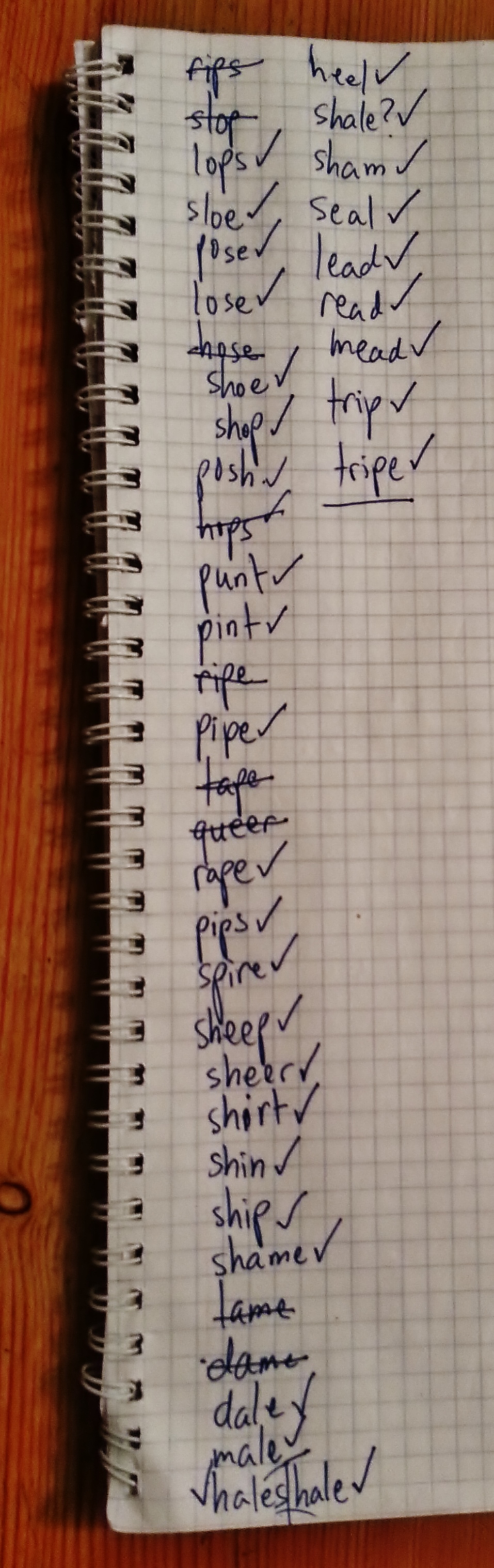 My mother and I often play Big Boggle (5X5 tiles, not 4X4), which, for those who don’t know, is a word game in which you have a limited amount of time and you have to write down as many words as possible. Since we got to be too good at it, we decided a couple years ago to limit ourselves to four-letter words, eliminating the endless and obligatory three-letter words that show up way too often and make the game repetitive (tea, eat, ate, rat, art, tar, pat, tap, apt, etc.)
Tonight, for whatever reason, this list I made seemed to work very well as a slightly sinister, possibly political (class and gender commentary?) poem. It wasn’t on purpose, but as I was reading the words out, it just seemed to work out that way. So, as you see above: my first ever piece of found poetry. Read it however you want – with the crossed out words or without, across or top to bottom, it works out somehow. I’m quite proud of the bizarre and happy accident (less happy about sharing my atrocious handwriting, but, there you go.)
 Slightly Ignorant