“Man, that’s annoying.”
“What?”
“Don’t you hear that noise? That eee-hee-eee-heee?”
“Uh- oh, yeah, I guess. Is it driving you nuts? Want to go in?”
“Nah, it’s fine. Sorry. Go on.”
“Okay. So yeah, so I was telling her about how it was, you know, meeting the other girl- woman, sorry, sorry, woman- and she was fine with it. What?”
“Huh? No, sorry, I mean, yeah, I’m listening, it’s just that noise. I’m trying to figure out what it is.”
“I think it’s like a rusty metal gate or something. You know. The wind moving it or something.”
“Oh yeah. Yeah, you’re totally right. Anyway, do you really think she was alright with it?”
“I don’t know, see that’s what I’m saying. I think so. Besides, she can’t keep her mouth shut when she’s not, right? Like, we know that by now.”
“Do we?”
“I mean, I didn’t mean it like that, you know what I mean. It’s just that she’s honest with me. You know? Like to a fault.”
“Yeah, I guess, but I – what? Mom, I can’t hear you! No, I’m outside! I’ll do it later! Sorry.”
“It’s fine, no worries. Do you want to go talk to her?”
“No, no, no, she can wait, she’s just annoyed about the laundry but I told her earlier that I’d do it after you left. So it’s like totally fine. Don’t even.”
“Kay. So…”
“So yeah, anyway, what I’m saying is, I don’t know that she’s honest with you. Always. I mean, are you sure?”
“Totally sure. I mean, trust me on this. I know it.”
“Okay. But so how is that a bad thing? I mean, if she’s honest with you, and she seemed fine with it, then it’s fine. Right?”
“Right. I mean, yeah. It is.”
“It is?”
“Yeah. I think. I mean. Yeah.”
“But…?”
“Nothing, no, nothing, it’s just that she always seems so tense, like she does want to say something but she can’t say it and it’s kind of annoying, you know?”
“So you mean she’s not fine with it.”
“She says she is, though! And even if not, it’s not like I can do anything, right? Right.”
“Right. Except like talk to her some more.”
“Yeah, I guess. But we talk so much. I mean, like, I like talking to her, I love talking to her, obviously, but I’m just sick of it being like, you know- listen, you look like you totally can’t stand that noise anymore. Sure you don’t want to go inside?”
“Yeah, I’m sure, I’m sure.”
“So-”
“Actually no, it’s totally making me go crazy, let’s go in. It’s like once you realize it’s there you can’t stop listening to it, right?”
“Yeah, totally. But it doesn’t bother me as much I guess.”
“How? It’s like the most annoying noise on the planet. Eee-uh-ee-hee-uh.”
“You’re bringing it inside now too?”
“It’s stuck in my head, man, like actually, it’s awful. Anyway, coffee? Tea?”
“Sure.”
blogging
Oh, Neil, I’m getting lazy
My writing habits have become abysmal lately. I still write every day, because by this point it just feels weird not to. For a week and a half or so, when I was on holiday and barely touching my computer, I didn’t write except the odd quick email or instant message on my phone. But other than those few days, I don’t think I’ve not written for an extended period of time in about a year now – be it parts of an essay, notes, comments on other people’s posts on the web (more thought-out than they should be, maybe, but still), long emails, or fiction. There’s not a day, anymore, where I don’t think about my writing, the work-in-progress I have going on, or allow ideas and sentences to germinate in my brain for further use. I lose the latter more often than not. Another of my bad habits is my inability to commit to keeping a notebook on my ACTUAL PERSON at all times. I have more than one, as well as pens, in my backpack at all times, and that backpack is with me wherever I go. But it’s not the same. Needing to rummage in a backpack isn’t the same thing as being able to whip a notebook out of my pocket and jot something down. I need to either find jeans with bigger pockets (damn you, girl jeans!), find some way to stuff a notebook into my bra (there’s definitely a business idea waiting to happen there – easily bendable, stuffable notebooks, for any crevice of your body you may want to keep one in) or else just start walking around with a permanent marker and jot things down on my hand. But then, if they’re no good, I won’t be able to wash them off. And I’ll run out of space pretty quickly.
The real answer, of course, is to get back into a more routine writing habit. At least, that’s the answer as far as I’m concerned. Every writer has her or his own ways and means and needs. For me, writing every day for an extended period of time that is for my own purposes – not for schoolwork, in other words, and not out of a feeling of obligation to anyone but me – is the best way to make sure I use the things that float around my head all day.
Noticing New York
Some people notice the buildings. They look up, the backs of their necks wrinkling like old men’s foreheads, and they strain their eyes and get dizzy with vertigo. They notice the heads carved above the windowsills on lower Broadway. They notice the snazzy designs on the Flatiron and the dials on the elevators going from the lower tracks to the main concourse of Grand Central.
Some people notice other people. They notice the variations in skin color and, for the first time, stare at their arms encased in black coats and gloves and their chest wrapped in scarves and realize that on the crowded bus where the windows are all blocked they cannot see any reflections of themselves. They notice the possibility of their skin being any color at all; they could blend with any of the races siting around them or be a mix of any or all of them. They could be green or blue or polka-dotted and it wouldn’t matter in this moment.
Some people notice the reactions, the connections, the bizarre randomness of people finding one another in lines for coat checks, on street corners, inside corner delis, before entering a taxi, upon exiting an elevator.
Noticing everything in New York City is impossible. Noticing as much as possible is the constant, ultimate goal. It is a city evolving and living up to and through every stereotype it has ever had while building new and unique traditions for itself at the same time. Things are old and new, familiar and strange at the same time. There is a sense of having been everywhere before and seen everything, even as the unfamiliar shadows of taller buildings than those ever encountered before fill the streets and avenues. New York is a city of unnoticing lives being noticed by noticers.
Homeless
You love your work. You’re thankful every day that you get paid, even though the donations trickle in slowly and the funding gets cut year after year. You still have a salary and you’re still doing something important. Something you care about. Something that moves people. You are in the very kernel of life, eighty-thousand leagues below the sea and down deep to the center of the earth. You have two children and a partner and you love them all. There are good days and bad days, because life isn’t perfect. But when your fortieth birthday rolled around, you were happier than you’d ever been in and you wondered whether people could see it on you, on your lined face and in your tired eyes. Happiness, joy, you’ve come to realize, are quiet things for you, and you experience them in the pit of your belly and the tips of your fingers and in the peace that falls on you when your head hits the pillow and you smell the familiar body of the person you’ve chosen to spend your life with stirring beside you.
Two weeks after you turn forty, you get the assignment. You accept it, because you’ve never turned one down before. You will do your best, but you’re not sure how to begin. You make the usual phone calls. You do the necessary research. You watch the episodes of the better TV shows that involve these people whose lives you’re supposed to start showcasing. You get lots of help. But when you walk to the metro that whole first week you’re more aware than you’ve ever been before. Your eyes have been opened. You see them everywhere, lurking, smoking, talking, even laughing. You see them going into stores and buying things. You notice that they have cellphones. You see them near churches. You see them rummaging in their bags and baskets.
You don’t approach them on your own. You’re too scared. Too nervous. You feel superstitious about them. They are your black cats and ladders and umbrellas inside the house. They threaten to shake you out of your joy. They’ve already begun, without knowing it.
The couple you speak to, the pair of them, have been handed to you on a silver plate by a charity who wanted to help you. You’re grateful to the charity, to their contribution, which feels strange since normally it is the other way around with charities. They’re grateful to you, usually. The couple they’ve supplied are perfect for your story. They’re around your age but look like your parents, they have health problems, they are coherent and can be recorded. You go with them everywhere, that first day. You took with you a wad of five dollar bills in your pocket, anticipating the need to get them to cooperate with you. You’re surprised. They talk to you as if you’re a tourist to their world. They’re eager to show you around, share their complaints, explain their situation, but they don’t ask for a thing in return. It’s another upside-down situation – you’re the tourist, but they’re asking you to take the sound-bite photograph of them. They trust you with their lives. The man lets you hear him begin to cry in the soup kitchen as he worries about his partner’s health, and you wonder if you would feel the same responsibility in his place, caring for this woman with no teeth. The woman looks at the man, concerned at his expression of emotions, so rare and untried, and you wonder whether you would worry about another man’s feelings if your legs hurt all the time as much as hers do.
You are brought into reality by them, and it is painful, a red-hot poker to your guts. When you fall into bed that night, your partner rolls away from you and mutters that you smell of smoke. You sniff. You showered, but didn’t bother washing your hair. You were too tired. You imagine the couple, stretched out on the sofa bed in your living room, piled under duvets and heads resting on clean pillows. They aren’t there, of course. They’re in their tent underneath the highway overpass, where you left them earlier. You left them where you left the job, somewhere else, to be resumed and returned to tomorrow, when you’re ready to leave your home again.
________________
This story was inspired by this news story on NPR’s All Things Considered. It is entirely invented and bears no real relation (besides that imagined) to the reporter or the subjects of the story.
Exhaustion
A carbonated drink fizzed as the cap was screwed off the top of the bottle. A spoon scraped around the little cup made of styrofoam and cancerous chemicals. A baby cried. I stared out the window and listened to the cafe make the sounds of life behind me, and I wondered whether I should participate. My brain felt sluggish. I could move and think and speak, and had been doing so all day, but it seemed as if I needed to make a conscious effort to do these things. I needed to think “move” before I moved, “speak” before my lips opened. It was disconcerting, being so bossy towards myself.
The mug of tea in front of me had gone cold. My hands felt heavy with the weight of too much awareness. I looked at them, trying to see whether there was a visible difference in grams. Maybe they were actually heavier. But no, they looked the same, large palms, long fingers, the joints closer to the palm seemingly chubby and oversized to me.
I wondered whether a parade of Disney characters walking outside would energise me. No. Probably not. Maybe a spiritual experience, an Angels in America kind of revelation. Too much energy. The perfect thing, really, would be if the cafe disintegrated behind me and the chair I sat on turned into the foot of a bed and I could simply let my body go, entirely, all at once, and lie down. I would sleep for hours, maybe forever.
Some Instincts
Shivering through space, Daley tiptoed across the library in her overcoat, gloves and woolen hat. Every cough ripped through her throat like ice chips going up rather than down, the reverse of her favorite summertime treat, crunching posicles in the yard before they melted.
Her body was a nesting place for germs and it made her uncomfortable to be around people who could catch her diseases but she had no choice. The world hadn’t stopped when her fever had risen to 102. The shelf she was searching for was being elusive, skipping around the library and purposefully evading her.
Terry’s blue and black coat flashed in her peripheral vision and warring instincts kicked in. She didn’t want him to see her like this but she wanted him to see her, to remember she existed outside the universe of beer pong and lax boys sucking on helium balloons for a laugh. Terry wasn’t above that sort of thing – Daley liked to think she was – but he had something to him that was more than that as well.
She couldn’t decide what to do quickly enough, and so he was gone, slamming out of the library like everyone seemed to do, as loudly and disruptively as possible. The sound reverberated in her head and she still couldn’t find the shelf mark she was looking for. She wished she could ask for help but her voice was reduced to a crow’s scratchy caw and whispering hurt even worse.
It was time to give up, she realized, surprised that her body had already figured this out and that she was falling to the floor, knees buckling, hands pulling some books off the shelf with her just to make sure that someone would hear and come running.
At least, she thought before everything went black, some instincts are still working.
Vacancy Filled
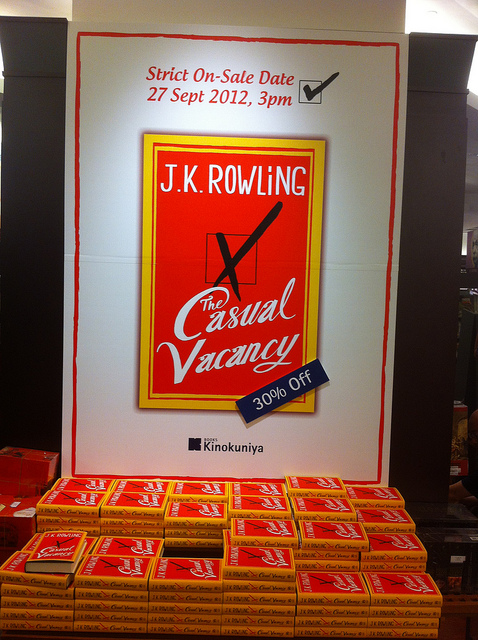
PHOTO / Marc van der Chijs
If it were possible to approach the subject of JK Rowling without discussing her previous work, I would do so. To mention the name “Harry Potter” is to bring up an entire slew of associations, whether positive, negative, or bored-to-tears indifferent. As a disclaimer, I must admit that I am a fan – the kind who always appreciated Rowling’s works on its own merits, first and foremost, and only then pinned a Hufflepuff badge on my backpack. I was, and still am, a devotee of the seven-book series, but I dislike the films, and stay away from the vast and – to me – frightening world of online fan-fiction.
It is as a writer rather than a celebrity that Rowling became a published author, and she wrote the Harry Potter books in a particular style. Her voice has always been uniquely hers, from the very first particularly, peculiarly, English sentence of the first book – “Mr and Mrs Dursley, of number four, Privet Drive, were proud to say that they were perfectly normal, thank you very much.”
The Casual Vacancy, JK Rowling’s first novel since she completed the Harry Potter series and its various offshoots, was promoted, disappointingly, as if it was an extension of the HP universe. The books filled the entire wall of shelves behind the Waterstones cash registers here in Oxford, the novel was promoted and given lengthy reviews in major magazines and newspapers, and it was generally treated as if it was going to be another merchandisable opportunity for the likes of Universal Studios and Sony (who each, respectively, runs the Wizarding World of Harry Potter in Florida, USA and the online virtual book-world Pottermore). While the reviews were very mixed, running the gamut from glowing to scathing, the book was generally treated as the work of celebrity rather than what it was: a first literary novel by an author who was (as she admitted to being) both proud of her book and wary of its reception.
Rowling has now proven that her voice is consistent. The language in the novel is simple and straightforward, while blindsiding the reader here and there with a brilliant observation or description that is shocking in its apparent clarity. Her vivid English-isms aren’t lost either: each section of the book opens with a quaint quote from a 17th century book of parish-council rules.
What is most amazing of all, however, is Rowling’s heretofore hidden talent for writing some truly despicable real-world characters. It is wonderful, exhilarating and endearing. A discussion that is still common in the writing and publishing world is the difference between men and women authors and their aptitude in writing unsympathetic characters. Women are often said to write too “nicely”, resulting in books of lesser merit or critical acclaim. Rowling strikes a blow for women authors everywhere in not softening her novel just because she is known also to be a children’s author (although, as an aside, anyone who claims that the Harry Potter books are for children may want to take a second look at them).
The Casual Vacancy’s characters are unflinchingly, unapologetically, and unabashedly nasty, one after another: Samantha, a middle-aged woman who ends up snogging a fifteen-year old boy while drunk at a party; Howard, the morbidly obese town bully who touches Samantha’s ass every time he sees her, though she’s married to his son; Simon, who buys stolen goods and hits his children and his wife but still thinks he’s one hell of a swell guy; Fats, a middle-class teenager who believes that it’s more ‘real’ to sleep with a girl from the slums he doesn’t actually like, because having a tough life is cool and enviable. Listing the characters like this makes them sound almost ridiculous, but Rowling’s superiority as an author is that each character is absolutely believable and has a motive and reason for acting as he or she does. Though the reader may end up hating them, she also ends up understanding and empathizing with them.
Rowling’s powerful novel deals with big issues – from ambition, loneliness and family to race, addiction and poverty – but it doesn’t shove any moral notions down the reader’s throat and it doesn’t offer idealistic, impossible, solutions. It portrays a slice of reality between its two covers, a story worth telling and worth reading, and, yes, (for those for whom this is the main the draw) it gives the reader the bizarre pleasure of seeing the word “fuck” written many times by the same woman who invented the snitch, butterbeer, and Dobby the house-elf.
The Sky
“Mama. Mama. Help me, Mama. I’m alone. I’m afraid. Mama.”
He is blonde. Dyed. He is black. Self-identified as. Father unknown, discounted. Skin’s dark enough, mother’s is too.
He is drunk.
He is standing on top of a table in the middle of a room. The table is ornate, but not old. It is expensive. The legs are carved with animals that cannot anatomically exist in this world. There is a tablecloth beneath his boots. Its red and white checks are stained with mud, stained brown and green and mauve from the flowers littering the grass outside that have fallen off the trees and get onto everyone’s shoes.
The music is loud. Louder than him. His lips move with his confession and his arms are stretched, pointing up, fingers touching the sky, he thinks, but it isn’t the sky. It is the ceiling. His nail catches on a splinter of paint and he pauses. He is shocked. The sky is falling.
The sky is falling.
He is bawling.
Stone Folly
Forgotten by generation after generation of men and women, the old stone building sat in the middle of the grassy meadow. Time, however, had not forgotten it, but had caressed it, each year adding to its predecessor. The stone turned browner in the summer and grayer when the rain and snow washed away the accumulating dust of summer. Vines grew and shriveled and grew again on the building’s walls, wrapping it like a comforting green blanket as the seasons and years passed.
The stone building had no doors. It had no windows. It had no chimney. It was entirely closed, impossible to get in. Eventually, when it was rediscovered by humanity, it was seen as a curiosity. When architects and historians tried to discover who had built it, they couldn’t find records of it. An old manor house had burnt down some miles from the site of the stone building, but there was no record of the wealthy family to whom the manor house belonged having ever built the structure. Farmers in the vicinity all said that they didn’t use the meadow because their cattle didn’t like grazing in it. They said they trusted the animals’ instincts and stayed away.
When it was written about in guidebooks, it was called a folly – a building constructed for decoration, for aesthetic purposes only, that had absolutely no useful value. The name commonly given to it was “The Stone Hut in the Meadow”, as if it was impossible to think up a more imaginative title that wasn’t strictly descriptive. The truth was that it didn’t really matter. Even now that the place was marked, mapped, written about and remarked upon, it didn’t draw many tourists to it. One or two hopeful tourists would stop by every couple weeks, hoping to find a picturesque spot to take photographs in, but they were usually disappointed by the simplicity of the house. There were teenagers who sometimes trekked to the stone building on a dare, hoping to be the ones to find a secret way into it, but they were always let down as well.
So it was that even though the stone hut was recognized, it was largely an empty, desolate spot.
**
Ruvy Ben-Shalom, a dark and grizzled man, walked along the highway and wondered whether he was going to reach a Denny’s or Dunkin Donuts at any point in the near future. At the last intersection, he’d managed to flag down a car. The woman had two small boys sleeping peacefully in the back seat, and she’d opened her window only a crack, to ask if he needed her to call anybody for him. She’d refused to give him a ride, but pointed him down this route as the best way to find the nearest rest-stop.
He knew he looked like a hobo. He wore black gloves that were two large for his small, delicate hands, and his eyes must look large, hungry and sleep deprived. Probably, he mused, because he was hungry and sleep deprived. Sleeping out in the open during the cold nights was no picnic, especially along these apparently endless highways that went from one nowhere town to another nothing town. He always arrived at inhabited places too late, when everything was already closed. Rest stops, though, had diners and McDonalds and bathrooms that were open all the time, and he yearned to sit town on a toilet and wash his face at a sink. He couldn’t wait to get a cup of coffee into his aching stomach, even though he was exhausted.
On his right, through the gloom of dusk, he saw a stone building. It was smallish, about the size of a two room house – he couldn’t help but compare it to the home he’d left two weeks ago – but it seemed to be pleasant enough. He wanted to go and see what was there, because it was beautiful. Something about it called to him. There was a great deal of grassy meadow to get through, first, and he walked into the grass rather unwillingly, getting his pants wet almost at once. He cursed softly, under his breath. The dew was collecting on the long stocks of overgrown weeds, and his cargo pants, which were already cold and too thin, got soaked, immediately. At least his boots were waterproof.
The little stone building’s walls were covered with ivy, except for a perfect square where the doorway was. Someone had very neatly pushed and tidied the ivy away from it, and it looked far newer than the rest of the house. The door was bright red and looked freshly painted and shiny.
Ruvy knocked three times, before thinking about it for long. The door opened, and he began to sob.
How to Avoid Awkward Airport Encounters
1. Walk around too fast. People at airports tend to dawdle, to meander, to amble. Avoid this at all costs. Walking slowly allows you to be caught by people you might know. Walking very fast and appearing to be late, frazzled, nervous or just weird will help to keep people from looking at you with too much concentration. Your face will also be blurrier.
2. Keep your gaze at far above or far below eye-contact level. Look for your flight on the screens repeatedly. Read your book while walking if you’re me.
3. Loiter in bathrooms. Peeing is healthy for you.
4. If you do encounter someone you know, have excuses at the ready. Make sure to have booked a seat in advance so that you don’t have to chummily sit together on the airplane. Drink lots of water so you can duck out and go pee during the conversation. Postpone any duty-free shopping until last possible minute for same reason.
5. In order to avoid steps 1-4, stop being a big baby and deal with the option of awkwardness. Remember that you are able to converse like an adult, that you are good at asking questions, and that you actually aren’t as anti-social as you sometimes think you are. Remember that you are ridiculous, suck it up, and take a deep breath. Things will be fine.
6. If step 5 doesn’t work, repeat 1-4 until step 5 becomes necessary once again.
 Slightly Ignorant