1. She never listened to her father’s absence of breath.
2. She never said No when it really mattered.
3. She never said Yes when it didn’t.
4. She never watched her mother cry in the mornings.
5. She never learned how to prevent everyone else’s pain.
6. She never learned how to prevent her own.
7. She never dove in headfirst knowing what was waiting on the other side.
8. She never clarified the terms of her contract.
9. She never bothered to create legally binding contracts for her clients.
10. She never paid her taxes without someone else’s help.
11. She never corrected her own grammar if she thought she could get away with it.
12. She never became a ballerina.
13. Or an actress.
14. Or a dishwasher.
15. She never stopped loving anyone.
16. She never liked someone in the same way as they liked her because she believed that it was a human impossibility to like and be equally liked in return.
17. She never learned how to hate.
18. She never learned how to avoid jealousy.
19. Or envy (which is different).
20. Or schadenfreude.
21. Or guilt.
22. She never learned how to horseback ride.
23. She never took a step off a twenty-five story high building.
24. She never shot herself full of things she wished she could, even for the story.
25. She never felt entirely sure.
flash fiction
Gold-Ringed Syringe
“Put it in me already,” Nell says through the strap in her teeth. I tease her, waving it slowly in front of her, the beautiful gold needle that has a ring to one side for one’s thumb, to keep it steady, a ring which is almost an exact replica of those surrounding our fingers.
“We’re celebrating today, remember?” I say. She nods vigorously, her veins popping out, her head pulling back to pull the pure leather belt around her upper arm even tighter. I’m worried she’ll end up cutting off her bloodstream entirely. “Calm down.” It’s a command, not a request, and she lets the strap loosen just enough. “Good. Good girl.”
She moans, and her eyes are brimming with tears, which she learned to bring on artificially in some acting class in college, but it convinces me and I finally put the needle to her vein, slip it under the skin and draw back, see the blood, no air bubbles, and push back, plunging all the way down, all the way into her. She lets the strap loose, or it falls out of her mouth, and her eyes roll up to the ceiling and she smiles lazily before even that amount of work is too much for muscles and her face goes slack. I pick her up – I’m taller and stronger than her, always have been, they call me the butch, even though they don’t know what a top she is in the bedroom – and lay her down on the couch.
I watch her, ignoring her occasional mumbles about things we need to remember to do, or things she wants me to do to her now. She’s not gone to the world, not entirely, but she is in the land of cotton wool lightness and lying down keeps her safe. Plenty of people walk around like this, but Nell and I have never understood how it’s possible.
My phone buzzes on the coffee table and I pick it up. It’s one of my clients. I automatically begin to pace.
“Hello, Tonya, how are you?”
She tells me how she is and begins to ask about her portfolio, about what I’ve done with her investments this week. She’s not seeing the rise she wants to see.
“Tonya, darling, don’t you trust me? I would never steer you wrong. I can tell you that the two new companies are going places, you just need to wait until the end of the week, you’ll see – they have something new up their sleeve is my guess because they’ve been throwing a lot of hints out there.”
She continues to complain and I sit back down on the coffee table and only listen with half an ear. I watch Nell, smiling again sometimes, her eyes opening and closing slowly, an air bubble popping through her lips and making her simulate a giggle though no sound comes out. I reassure Tonya, finally, and tell her I’ll call her on Friday. I need to stop giving clients my cell number, I remind myself, but they need it, unfortunately. I’m extraordinary at what I do – otherwise how could Nell and I afford this place, this syringe, the clean as fuck dope – and people who make money off of me are paying commissions up the wazoo so I better be available to wipe their ass if need be.
There is only one day I don’t answer the phone, and that’s the day when Nell does it to me. We take turns, once a week her, once a week me. We’re careful. We love it. We still go to meetings, and fake our way through chip after chip. Every one we get we bore a hole into and string it on this long ribbon that we hang on our balcony. It rattles, our personal version of wind chimes.
We like the meetings, the validation, the friends we’ve made, the comradery. And we feel fine.
Once a week for each of us. That’s it. That’s nothing. And it doesn’t count because we monitor one another. We’ll never hit bottom again. Bottom wasn’t fun, and we’re both happy to be here, up top. Nell’s massage business is booming and I’m back on Wall Street like nothing ever happened. So what if I met Nell at rehab. So what if you’re not supposed to date there, or in your first year after. It’s okay. We both talk to our sponsors about it. You don’t run away from the love of your life when you encounter her, no matter where you both are.
Nell raises her head a few hours later. I’m curled up at the other end of the couch with a book, playing with the syringe between my fingers. I’ve always had restless hands. “More?” she asks. I smile, and go and get the rest of the kit. What’s one more time in one day? Still nothing.
Rocks are Solid but the Heart Goes Squish [FICTION]
Hush, my mother tells me. I have been through this and we were lucky to have loved so deeply. But why, Mama, if you loved so deeply, I ask, did it happen? She shrugs. It happens, she says. It is complicated, she says. So why, I ask, cannot I be complicated? Because, she says, no one will like you in the end.
Hush, my best friend, dressed in two guises, tells me. Don’t breathe a word, for you will surely be injured. By rocks and spitballs, stomping cloven hooves and razor sharp nails. But, I say, my skin has been pierced, my heart is hard, my limbs are strong and my mind is sound. Is it, my best friend, dressed in two guises, asks? Is it sound? It is sound enough. My best friend, dressed in two guises, shakes her head and sighs.
Hush, my therapist tells me. Dial down your honesty. Nothing good will come of it. It will serve to hurt you and the others. It will cause a break and a fall; a heart pounding resuscitation may be needed. Why, I say, can I not be honest when honesty is the most challenging communication possible? With honesty, I remind my therapist, life is so much more interesting, especially as others do not practice it fully yet and may not ever. My therapist reminds me that my honesty has killed me before and I remind my therapist that it has also brought me back to life. I am like a curious cat that way, coming back satisfied, licking my chops from the bloody heart of a pigeon caught outside. Remorse and regret come later, like any human killer.
Hush, my married friend tells me. And I think, what if her husband was the one, what if she were the one too, what if their life was what I wanted and could not get? She would understand, she more than anyone, but she would not accept. Few would. Hush, she tells me. Write it out, the frustration and fear. Write out the rocks and do not throw them at your heart. You think it is solid, she says, but it is not. It goes squish when you hold it.
Hush, goes my heart. Hush all the voices other than mine, she says. Hush them all and speak out. Silence is worse than sticks and stones. Ask Alice innocent questions, ask why and how and wherefore art thou. Ask and buckle the answers tight around your waist and squeeze, until you cannot digest and cannot breathe, until your internal organs go squish like me, like your heart, an organ without voice or reason. Listen to my practical pumps of blood, my heart tells me. I have four rooms. You have filled two and one is brimming. You can stand to lose one chamber to a game of Russian Roulette.
Go Away
A chalky man walks around Dora’s brain. He’s hard to pin down, never stops long enough for her to get a good look. She knows he is a man, vaguely, or believes he is, because of the effect he has on her. He makes her squirm, not with pleasure, but with discomfort, as so many others have done before.
But the chalk man, unlike the others, doesn’t berate her. He doesn’t mutilate her. He doesn’t corrode her veins and swatches of her skin with verbal acid. His silence is far more terrifying. It is a waiting silence, a tense and pent-up silence, the kind of silence that you can pull like a piece of chewed up gum, pull and pull and pull until it snaps back and sticks to both fingers and is impossible to get off.
Dora walks through her life with this chalk man threatening her. His blurry outline haunts her when she works at the wood shop, overseeing the new people’s handling of saw and sander. He doesn’t distract her – Dora is not to be distracted – but she is as aware of him as of the cyst on her thigh that scrapes every time she walks. He is a physicality that she can put aside, that she can work with, but that she cannot erase with a hot compress.
One day, the chalk man walks through the doors of her workshop and looks around. Looks for her. Frozen, she stands next to a cabinet she has been decorating with delicate carvings, and sees him see her. She feels him come closer. She hears his voice inside her mind and ears both.
“Hi,” he says. “Long time no see.”
She wants to say I love you. She wants to say come back. She wants to say take me. She wants to say you hurt me. She wants to say, and touch, and forgive, and relive; she wants to drink beer in Munich and wine in Madrid; she wants to buy a house and decorate it with her furniture, and she wants him to carry her heavy things inside, to carry her inside too; she wants to erase his erasure of her.
“Go away,” she says. The live chalk man turns, a look of true disappointment blooming around his mouth and crow’s-feet eyes, but the chalk man in her head solidifies and keeps walking in circles.
It will take another year for the chalk man to blur again, to become unknown again, to restore Dora’s ability to keep her hands steady enough to work again. When the chalk man is blurry, he is safer. Not safe, never safe, but safer.
Journeymen
The first job of the day was simple. So simple that Rush could have done it in his sleep. An old woman hovered near him as he flicked up the fuse switches that had been overloaded and shut down by the summer heat and the overuse of air-conditioners.
“You have to be careful using the A/C, ma’am,” he told her. “Don’t turn the oven and the television and all the fans on along with it.” She nodded, eyes glassy with medical grade weed that reeked from her thick flannel nightgown. She was bald. Probably dead soon, Rush thought. He left the building, got back into his truck, and checked his list for the next job.
As he drove, he considered his recent predicament. Rush had never been in love with a married man before. It was a novel experience, refreshing as the cold spring near his first foster home. The good one. The spring had been icy and sharp on his bony feet, the tingle as close to arousal as he’d gotten as a child.
The married man was not unkind to Rush. He was a friend, sort of, a distant sort. They went out to drinks with the others occasionally. Rush had met him on the job. They were both union electricians, though Rush was only an apprentice and the married man was a journeyman. Rush knew this was part of the attraction. He was lower in the deck of cards than the married man, whose experience, precision with his tools, and dedication to hours of work made him a Jack, where Rush was only an eight of hearts.
Rush’s second stop of the day proved trickier. It was at one of the two community theater spaces in town and their equipment was old. He had to untangle wires, find their sources, stream new copper wire into select areas, running back and forth to the fuse box to turn the power on and off to see if things were fixed yet. He worked right through his lunch hour.
The journeyman was not only married, but married to a woman. This too was refreshing but in a less pleasant way. Rush had been attracted to plenty of unavailable gay men before; celebrities, prudes, closeted homos playing the straight and narrow for their Catholic parents. But never in his life had Rush felt something like this for a straight man. A married straight man. A married straight journeyman thirteen years his senior. The allure felt Austinian, Jamesian, Forsterian. Rush read things. He knew the married man did too. It was one of the things that had drawn them together, to an extent. An almost shameful love of reading.
The last job of the day for Rush was at a faraway location, out in the suburbs. He parked his trucked and saw that another was there already, its bed filled with similar equipment. This happened sometimes, double bookings, mixed listings, but Rush was unwilling to slack so he went up to the house anyway. The married man was there already, on a ladder in the garage. A woman with long nails painted a deep purple that looked more like shit-brown was hovering beneath him murmuring “Oh, be careful. Please be careful. Oh, please be careful.” She sounded like she was making love to the married journeyman, her voice breathy, her head thrown back to look up at him, her mouth hanging open between words. The married man said nothing, but continued to examine the wires surrounding the apparently defunct lighting system in the garage.
“Hi,” Rush said. The woman looked down and back up in confusion. The married man glanced at Rush and smiled.
“You’re the second one they sent. Guess they don’t think I can do the job.”
Rush laughed because he knew he was supposed to. “Need help now I’m here?”
“Nah. I’ll be good. It’s fine.”
“Okay. See ya.”
Rush fled the garage and got back into his truck. His heart was racing. The woman in the garage would keep making eyes at the straight married journeyman. Rush would go home and watch straight porn for the first time in his life, trying to figure out what the fuss was all about.
On this Mountain

“There is nothing a mountain can do to hurt you,” Brian said. We were in the car, heading towards one of his favorite hiking spots, and he could see my chest rise and fall as my breathing quickened and the way my cheeks got hot and my fists clenched. Anxiety, that’s what my doctor said.
Screw my doctor.
“I beg to differ,” I told Brian, except that I didn’t, because what was the point? He was taking me on this trip with an explicit and very obvious reason. A proposal. This wasn’t exposure therapy. This was a romantic gesture.
Screw romantic gestures.
Brian and I had history. Two years of it. And six weeks of dating before that, if it counts. “Meeting through an online dating website does not a forever make,” my mother told me when, in my honeymoon phase glee, called to tell her that I finally had a boyfriend.
Screw my mom too. Except she was right. At least in my case. Still, screw her. Screw her for being right. Screw her for planting that seed of doubt that’s now grown into a weeping willow that I can hide inside and feel safe in.
And then this mountain business.
Brian pulled our backpacks out of the back seats of his SUV, which he called his truck even though it wasn’t, and gave me one. It was lighter than his, almost for sure, but it was heavy enough to reset the disaster reel in my mind. Falling down backwards down the trail, falling sideways off the train and into a chasm, slipping and breaking a leg or an arm or a rib or my head, being attacked by a wild boar or a black bear or a snake or—
“Ready?”
“Yup.”
I followed him towards the base of the trail. I watched his boots thunk down and tried to match his pace. I had always been a devout shoe-watcher. My mom always told me to put my chin up, to be proud, to let others stare at my skin if they had to but to know that I was beautiful. I didn’t know how to explain her that looking down had nothing to do with any of that. Nobody knew where to place me, so everyone put me in a comfortable box and didn’t see me as a thug, because I wasn’t big or a man or dark enough to be a thug. I knew thugs, real ones and ones who just looked it, and they didn’t think I belonged to them either. Mom thought I belonged everywhere. That I was some free-spirited sprite like her, able to jump through environments and homes and societies like an acrobat. Instead, I put my head down and found things that were interesting and similar everywhere. It was easier to move around when I knew that no matter where we went, I’d have shoes to look at. Almost everyone wore shoes. The ones who didn’t, I knew, were even more on the outside than I was.
Brian’s shoes were sturdy yellow Timberlands. I’ll say this for him – they were broken in, not shiny and new. He really was a hiker. He said he was many other things that he wasn’t (tender, intelligent, original) but this one thing was true. He loved the mountains. I used to love that about him.
On the trail, Brian made me go in front of him and kept up a running commentary, so I could never forget where we were.
“Careful of that rock, babe. There’s a tree branch coming up on your left. We’re going to curve here, so don’t look down to the left, okay? It’s not that far but I know it freaks you out so just don’t look. There you go. Good girl.”
Idiot. I wasn’t afraid of heights. I lived in cities all my life. I was afraid of nature. Of this mountain we were on. Of what would happen at its summit.
It was beautiful, I was big enough to admit that, even with my sulky silence. The air smelled different, tasted like cold water when I breathed it in. The trail itself was nothing special, but the views of other mountains was more impressive than the view I was used to: a bunch of identical high rises in what was called, in every city I’d been to, the ghetto.
I was still scared of the mountains. Man made disasters I could understand. I grew up seeing people get into fights that left them bloody. I knew gunshots when I heard them. Sirens were a constant, and the sound of pounding meat as cops beat up on other people was more familiar than any tree. I had no idea what trees were around us. I didn’t know more than a handful of names for tree: birches, furs, weeping willows, regular willows. Apple trees. I knew there were more, but it’s not necessary knowledge for a city-dweller.
An hour in, when Brian told me we were halfway there, I stopped. He bumped into me. We fell. I screamed, even though we were nowhere near an edge. We were firmly in between large rocky bits, on a trail that made a little valley between them. There was dirt in my mouth and Brian was cursing, and he got up and tried to help me, but I only turned over off my stomach and sat there, spitting out dirt and taking swigs from my water bottle and spitting them out too.
“You’re wasting our water,” Brian said.
“I thought you said we had enough for four treks like this,” I told him with a thick tongue, still trying to expel the feeling of dirt from my mouth.
“That still doesn’t mean you should be wasting any. What if something happened?”
“You said nothing could happen.”
He shut up, knowing it was better not to argue with me when I was like this. I would win. My logic was as curving and twisted as a Möbius strip. Those I knew about. I was one of the ones who paid attention at school. Every school I went to, the math or science teacher (sometimes both) did the Möbius strip trick for us, trying to show us how cool it was, how it defied logic or didn’t or something. Once it was an art teacher who showed us how to make one.
Brian wouldn’t sit. He stayed standing, bouncing on his toes. Everything was going wrong, as far as he was concerned. I wasn’t having fun. It was getting colder than he’d meant it to get. And we weren’t moving, which meant he wouldn’t be able to time his proposal with the pre-sunset colors.
“I want to go back down,” I said. He kicked a pebble around with his foot.
“After all this way?”
“We’re only halfway. You said.”
He didn’t say anything. A gust of wind blew through our clothes and hair. It smelled delicious. I wanted to grab it in handfuls and put it in my pocket and breathe it in every time I had to pass the garbage room and the hallway of my apartment building which smelled like piss.
“I’m going to say no, Brian,” I finally said.
“I know.”
“Then why did–”
“I thought the mountain might change your mind.”
I snorted. “And you say you’re barely Indian.”
He was a half blood like me. No one knew where to place him either. It had been part of what drew us together originally. There was a lot of ground to cover when it came to identity. We had an endless supply of conversational material. Not a day passed when we wouldn’t call or text each other with the latest slur, awkward question, or odd look directed at us.
“Yeah, well.” He was quiet, a shoe-watcher, looking down at his Timberlands and moving them around, back and forth, a tiny dance of discomfort.
“I still love you,” I said.
“You do?”
“I just don’t know how much yet. I don’t know if it’s a forever love.”
“I do,” he said.
“I know you do.”
“Okay, come on, get up,” he said, helping me to my feet.
We began walking down, him in front this time. Either he didn’t want to look at me or he trusted me to walk well enough on my own now. Maybe both. I followed him, keeping an eye on where he placed his feet, and tried to put mine in the same spots he did. His stride was wider than mine. I had to stretch to match it sometimes. I was a game. I was having more fun now. I pointed out birds I’d never seen before, and the shapes I saw in the shadows of trees. Brian answered when I spoke, and I could hear a smile in his voice. Maybe even relief. Maybe I just wanted that part.
We unloaded our backpacks into the backseat of the truck that wasn’t and got into the front. I reached over to kiss him, and he kissed me back. I could feel the lump of a box in the pocket of his flannel shirt when he leaned against me. I put my hand on it.
“Keep it,” I whispered in his ear. “Let’s wait and see.”
He drew away and started the car. “Maybe next time,” he said as he drove us out of the parking lot, which felt more familiar to me than the mountain dust clinging to my clothes and hair. “Maybe we’ll make it to the top, next time.”
The story above got an honorable mention from the judge at Hour of Writes, who was reading the pieces blindly.
Image / flickr: Doug Wheller
The Barista
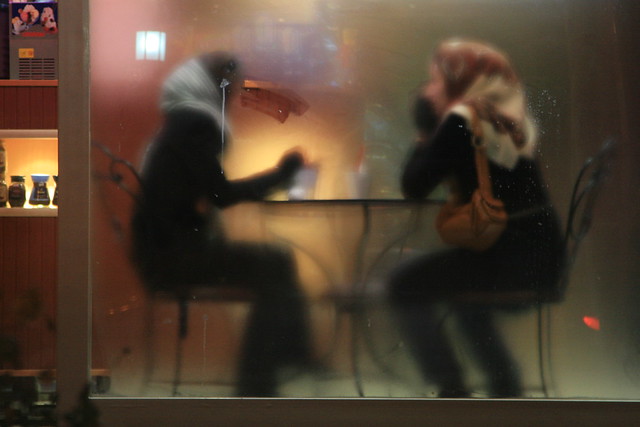 See the scene: a table made of real wood; chairs too; a drone of unintelligible conversation punctured by ire and laughter (they make themselves heard above any din); a man, a woman; a beer, a coffee; one tipsy, one too sober for her own good.
See me, behind a counter also made of real wood. Reinforced with metal hinges. The structure must be sound. It has to fulfill health and safety regulations. Our kitchen has no wood, I believe. Wood absorbs moisture, I imagine. There is varnish on the counter, to prevent this very problem.
I watch them. They are no more or less interesting than the others here. But I take turns, and give each table its due. Even the empty ones. Especially the empty ones. Those allow me to think about what I saw, what I heard.
But now, it is this couple’s turn. Theirs, at their wooden table, one tipsy and happy, the other listlessly merry, There are many kinds of happiness in the world. Theirs is momentary.
“Can I tell you a story idea? I’m tipsy.”
“Please!”
“Okay, so-” but the tipsy one is cut off, because I am there, not-so-surreptitiously picking up the empties, mug and bottle alike. He is beautiful, this man, and I want him to notice me. I smile. He says, “Thank you.” I stop smiling. The sober one doesn’t look at me at all. She is checking her phone. She’s one of the workaholics. I’ve seen her here before. Only memorable because of her piercings. She is not interesting. She is only average.
I wait until they leave, and I follow them. The beautiful man, he gets on the subway heading downtown. The same subway I take.
I will look for him now. In every car. On every ride. He is not more or less interesting than the others I see every day. He is only more beautiful. No one is interesting. This I have learned from countless observations of the fourteen wooden tables, three-seat bar, and twelve-seater old slab of concrete where students clack on keyboards and read Kierkegaard with furrowed brows.
No one is interesting.
Image / Beshef
Not Dying
Miranda wasn’t dying. She was standing in the grocery store, in a long line filled with other people who were being multilingual and filling her head with confusion. But she was most certainly not dying.
She often reminded herself of this fact. It was a necessary day-to-day assertion. “I’m not dying, I’m not dying,” she would tell herself when she rolled over in the morning to turn off the Mickey Mouse alarm clock on her bedside table, stolen from her son’s room when he went off to college because it was so annoying that it actually got her up. “I’m not dying,” she would recite over the coffee maker, dancing from one foot to another on cold toes.
“Put slippers on!” Miranda’s mother used to yell – really yell, with spittle flying out of her mouth and veins coming to the fore of her face.
“I’m not dying,” Miranda reminded herself on the way to work and in the morning meeting and the noon meeting and the late lunch meeting and the dinner meeting. “I’m not dying.”
“You’ll catch cold and then where will you be?” her mother would ask. Miranda yearned to ask where indeed that would be, but it was many years before she worked up the courage. By then, her mother wasn’t a force to be reckoned with anymore, and it felt like a cheap, below the belt blow. There were better ways to get to her mother than this, she knew, but it made her mother smile to hear her daughter ask the question. “Dead,” she’d said in the nursing home. “That’s what I meant when you were a kid. You’d be dead. Kids die of colds all the time.”
Miranda stood in the grocery store line and listened to the Spanish and Greek and Russian streaming around her and knew she would never learn another language. One was hard enough for her to contend with. It wouldn’t help her to understand the chatter around her. The mothers were all probably telling their kids the same thing every mother tells her daughter. The men in big jerseys were probably talking about some game involving a ball.
“I’m not dying,” Miranda told herself every night before she went to sleep. She walked barefoot to her bed and tucked her feet into the coldest part of the mysterious temperatures found in crisp sheets and made beds. “I’m not.”
Mindfulness
It’s a hard sell. Mind minus body. The lumbering meaty thing is still there, with all its joints and hemoglobin and heart conditions. It doesn’t leave you just because you decide to value that tangled web of firing neurons and chemical imbalances called a brain.
You do value it. Of course you do. It’s what makes your body tick, it’s what allows you to run on the treadmill and eat falafel from a food truck at 3am with your date,
No, that’s not right. That’s your brain.
Is your brain the same thing as your mind?
It’s that kind of night. The kind where you’re asking stupid philosophical questions and waving a white flag of defeat in front of your responsibilities. You’re done. You’re through. No more tonight. You need a rest.
So how do you convince people to see your mind over your body? It’s hovering there, your mind, above and around and in between all of your bodily functions and orifices and fortunate features. But it doesn’t overlay them. It just sort of shimmers. Sometimes it gets noticed. But not usually.
No, when you walk down the street to the post office to send the birthday present you’ve owed your mother for three months now and the rent check you’ve owed for slightly longer, you are not a mind above a body. You are a theoretical person, with a theoretical mind, but mostly you are simply a collection of limbs and features that are recognized as human.
Are you?
Is anyone?
It really is that kind of night. Shut your mind off. Let your brain wander. Watch some TV. Stop thinking about that girl you saw on the train and wanted to talk to. She’s long gone. She doesn’t exist in your world anymore.
Does she exist at all then?
Does it matter?
Shut up.
Pandora and Schrödinger Meet for Tea
Pandora’s box was full to the bursting when she came upon Schrödinger in 1945. She’d sent him a letter, telling him of her special box, which was actually a jar, and he invited her to have tea with him at Oxford. He’d signed his letter with his usual messy signature but for the first time felt self conscious about it. He knew she would be beautiful.
Think of this, he told her when they’d identified one another on the appointed time at the appointed place. How do you know everything in your box exists? he asked her. He sipped his earl grey and avoided her eyes.
She shook her head and thought he looked mighty handsome for a man of his age. She especially liked his bow tie. It made him look like a little package all wrapped up for her. I know it’s real because of its weight, she said. Here.
He tried to take the jar from her but the moment she released it into his hands, his whole body plunged forward and in that split second he thought he saw the jar breaking, scattering shards everywhere, and a void in the shape of a human face bursting out of it. But no, he must have imagined it. As he straightened up, Pandora already had the jar clutched tight in her hands.
Do you see? She said, sighing. Nobody else can hold it. Only I. And it has gotten so heavy in the last few years. So heavy.
It’s all a matter of perception, Schrödinger said, peevishly. He sipped his tea and fiddled with his shirt cuffs. They didn’t seem to want to remain under his jacket but they also wouldn’t, simply wouldn’t, establish themselves evenly outside of it. He was certain he looked a mess.
Now look, he began again. Think of it this way. If you put a cat in a box, and you close the lid, and leave some food and water inside, but also some poison, and the poison will be released into the air as soon as you open the lid, and then you come back after a week, will you know if the cat is alive?
It depends how much food you leave it, she said. It certainly wouldn’t try to get at the poison. Cats have a good sense of smell.
No, no, you don’t understand. The cat is both alive and dead until you open the lid. It is in both states simultaneously until you try to observe it, and only then will it be either alive or dead.
If you say so.
But then don’t you see? Your jar, the evils of the world, all that. It is heavy because you are certain that all of that is contained there. All of it. But you cannot observe it. Correct?
Yes, correct.
Well, then, how do you know, truly know, that the jar contains anything at all?
I see what you’re getting at, Pandora said. She was disappointed. She knew the evil was contained in her jar, and she knew she was the only one strong enough to continue holding it. She thought of poor Atlas and which one of them was worse off.
I must go, she said, getting up. Thank you for the tea.
Schrödinger waved goodbye and watched her walk out of the tea shop. She seemed to shrink and grow older as she walked away, and by the time she was at the door, she was bent over almost double, her jar clutched in one hand while the other held onto a cane for dear life. Right there, right in front of him, he realized, had been sitting a woman both young and old at the very same time. It was all a matter of perception.
 Slightly Ignorant