Podium

He read from the podium like a man possessed by two demons. One, his own personal demon, was with him wherever he went, living inside him, pressed between his heart and his ribcage. This demon was purple, a kind of eggplant shade that most people hate, and that the writer reading liked. He sometimes dreamed at night of painting his walls this color, all of them, but he knew, in his rational, waking moments, that this would make him horribly depressed. His demon, anyway, was this color, and it was slimy, too, the way you imagine a snake feels. Snakes, though, end up being smooth, but the demon wasn’t, it really was slimy and wet with the internal fluids that seep and slosh around inside the body, making the mysterious machines in there work properly. It had a voice, this demon, a very deep bass that took over when the writer had to read something difficult. At the podium, the man moved his lips and felt the demon’s long tongue touching the roof of his mouth and click against his teeth to make the right vowels and consonants. It was a much better reader than he himself was.

The second demon possessing the man was the less tangible one that was nevertheless present. He was familiar with it because he’d come across it often in front of audiences such as this. It was a demon made of gasps and exhales, of expectations fulfilled and disappointed, a demon of projections of prior knowledge and snappy new impressions. An audience of sixty or eighty, all of whom had demons of their own lodged inside their calves or the small of their backs or between their thighs or up their nostrils, wove together a demon that hovered over the writer reading like the cartoonish personal raincloud, except he knew it wouldn’t rain on him if he did something wrong. In fact, he knew, the demon above him wouldn’t do anything to him, precisely. Instead, it simply descended on him, bit by bit, a mantle gifted to him. He didn’t want the gift most of the time, not anymore, and he wished he could give it back; his shoulders were already heavy with cloaks, with wraps, with the warmth of strangers suffocating him.

The man at the podium read, possessed, until his tears blessed his audience and cleansed his listeners. His demons were soothed by the salt water, but only for a little while. Until the next podium, the next audience, the next mantle taken up for a cause of unclear worthiness.
Frivolicking, a writers’ retreat

Swamping a small space inside an inn that is surely not in Surrey despite its name are several dozen frozen faces, dripping in the heat lamps. Masked in social-butterfly expressions, they eat brownies, pretzels and sip white and red wine. A few of the brave clutch bottles of cool green beer, proving their ability to think outside the box, which in this case is the social gathering they have gathered socially for.
A white man with white hair speaks from a podium to a room of mostly white faces. He is shrivelling up like an acorn’s shell left in the corner of the room during several seasons; the signs of decay are barely there but if you chip the exterior with a fingernail, all the little outside triangles will dust right off and you’ll be left with a wrinkled and broken thing that used to hold a seed of something great.
Polite claps. The writers flee as politely and unobtrusively as they can, in groups of three or four, pretending that their greatest desire isn’t to hide under the covers with their antidepressants, whether in bottle, pill, teddy-bear, book, television, or person form.
It is the beginning of what promises to be a gruelling, frightening and terribly – in all the disparate meanings of the word – illuminating two weeks

Found Poetry – Big Boggle

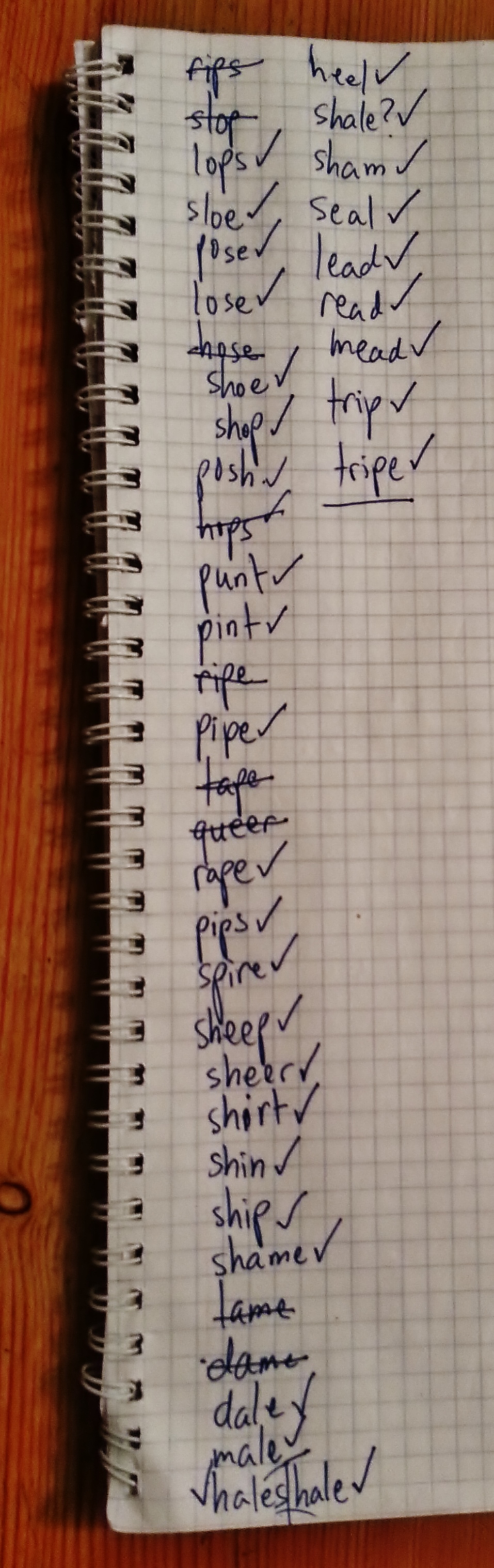
July 12, 2013 Big BoggleMy mother and I often play Big Boggle (5X5 tiles, not 4X4), which, for those who don’t know, is a word game in which you have a limited amount of time and you have to write down as many words as possible. Since we got to be too good at it, we decided a couple years ago to limit ourselves to four-letter words, eliminating the endless and obligatory three-letter words that show up way too often and make the game repetitive (tea, eat, ate, rat, art, tar, pat, tap, apt, etc.)

Tonight, for whatever reason, this list I made seemed to work very well as a slightly sinister, possibly political (class and gender commentary?) poem. It wasn’t on purpose, but as I was reading the words out, it just seemed to work out that way. So, as you see above: my first ever piece of found poetry. Read it however you want – with the crossed out words or without, across or top to bottom, it works out somehow. I’m quite proud of the bizarre and happy accident (less happy about sharing my atrocious handwriting, but, there you go.)

Correctional [Flash Fiction]

Photo / National Library of Scotland

Raw red and stinging, the bite mark hurt Gavin more than any of the many wounds he’d been receiving. It seared through the small, perfectly round, puncture mark and spread through his arm the way wildfire spreads in forests: first in a way that makes sense, treetop to treetop, then in a sudden burst appearing a hundred yards away in an unexpected spot, signalling that it’s out of control. His entire arm was now inflamed, including the shoulder, which was sending bolts of sticky white pain down his back, through his spine.

Gavin sat silently, alternately sucking and biting on his lips. He didn’t intend to make them bleed – he was in enough pain already – but the motion calmed him. He could almost imagine that his own lips were another’s, a woman’s. He’d never kissed anyone before. Unless you counted his mother, which he emphatically didn’t. He hadn’t let her kiss him full on the mouth since his tenth birthday, when his friends had seen her kiss him goodbye before going to play and had made fun of him all day for it. He’d never forget that day. He’d felt stuffed with chalk and stone all day, both heavy and so fragile that the lightest scratch would make him crumble.

He hadn’t written his mother in over a week. Now was a good time. It would take his mind off the awful bite, and Lord only knew what terrible insect gave it to him, and off his belly, which was gurgling with emptiness. There was a ration van on its way to replenish their supplies, but it was running late. No one knew way, not even the commanders, and Gavin and the others were trying not to panic. Some fights had already broken out, though. It was going to be a long afternoon if the van didn’t get here soon.

Gavin pulled his pack closer to him and spread his legs to settle it between them as a kind of writing desk. But even the small strain of keeping the pack balanced with his arm was too much. It was ridiculous, but there he was, lying awkwardly sideways, kicking his pack out of the way. He found a block of wood among the detritus spread around him and used it as a surface to keep his atrocious handwriting more in check than it would have been on the uneven ground. His mother’s letters, when he got them, were usually full of complaints, and one of the repeated ones had to do with her inability to decipher his scrawl. It made the process of writing to her all the more frustrating for Gavin. He wanted to assure her that he was safe, but it seemed that he could never get the message across.

Then again, he wasn’t entirely safe. There was a war on. He and his unit were moving from one camp to another, and none of them knew when they’d face actual combat. But they all knew they would, eventually. They’d reach a field, a valley, a dale – somewhere – where they’d dig trenches and face the dreadful others. The enemy. They’d pull out their guns, and they’d keep their tomahawks handy, just in case anyone got close enough and needed a last minute blow, even though everyone knew the knives were really mostly for show, and they’d kill people. He, Gavin, would kill people.

It wasn’t until he finished writing the letter to his mother that he looked up and realized that the ration van, meaning food, had arrived. His mouth went dry, his stomach gave a leap and a particularly strong gurgle before trying to convince him that, in fact, he wasn’t at all hungry – it often did this when he was excited – and his lips rested softly together, tired f their kissing practice. Food was more important than the idea of killing a man, or many men, more important than a pretty girl, more important than writing home. He got up and ran to join the other latecomers, praying to God that he wouldn’t miss out on anything.

Joss Whedon – the man, the legend, the awesome

A couple weeks ago – actually, a week and a half ago, to be precise – I went to a screening of Joss Whedon’s Much Ado About Nothing at the Oxford Union. I was privileged and lucky enough to get to interview Mr. Whedon himself, along with his stars, Alexis Denisof and Amy Acker, for almost half an hour. I then attended the general Q&A session at the Union, along with a whole lot of other fans who’d waited in anticipation for the event.

You can find the interview here and the article summarizing the amazing Q&A session here.


Two of my favorite people, talked to and interviewed in one year, in the span of not even three months. Not bad, for a loopy writer going into her senior year, if I do say so myself (but seriously, if you’d asked sixteen-year-old me if almost-23-year-old-me could do something like this, she’d laugh in your face and tell you to go pick on someone else and not make fun of her, please).


Untitled – A Vignette

The sparse hairs on Mr Fairchilde’s chin did nothing to promote the air of confidence he wore like a bespoke suit. He beckoned Eleni into his office with a small head dip, an echo of past centuries’ courtly bows, a concession to politeness he only expressed in physical gestures. In conversation, Mr Fairchilde was short, although in stature he was rather tall.

Eleni glided in, her feet obscured by her perpetual hippie-skirt. She jingled as she moved, obscuring any sound her feet might have made, giving her the illusion of true weightlessness. The cheap metal bracelets on her arms, peeling fake silver revealing coppery rust flakes, chimed as she swung them to and fro with far more vigour than seemed necessary for such a small person.

She looked around, surveying the tinseled, red and green bannered, generally over-the-top ornamented walls. They reminded her of the gaudy décor that hung at the corner bar, dug out of lumpy, leaking, boxes every holiday season and packed away with sweaty, alcohol soaked hands a week later. Mr Fairchilde’s reputation was sinking in her eyes minute by minute, and though she had no one to blame but her sister for recommending him so highly, she eyed him with the kind of distaste she usually reserved for small critters, hamsters and guinea pigs, which she especially hated.

“Anything to drink, Ms Cooper?”

“No. You get paid by the hour, don’t you?”

“I do. Business it is.”

They sat down, Mr Fairchilde taking his huge brown leather chair – brown, not black, he was sure, made him seem a little warmer than the usual solicitor – and Eleni in the right-hand plastic on plastic affair reserved for clients. She thought it would make more sense the other way around, with the client feeling more comfortable, more apt to waste time and money. It didn’t seem the thing, to consider the client’s need to be reminded that time was short and that any minute over the first hour would be charged as an entire second one. Like parking lots, the whole bunch of them, she thought.

“Why don’t you tell me what it’s about.”

“I told you over the phone.”

“Refresh my memory, please.”

Eleni spoke, telling him the things he wanted to know and watching him make notes on a legal pad which he held up on his knee, so she couldn’t see it. She imagined, as she often did, a film camera coming around her, circling, until it panned onto the lined yellow paper to reveal the punch line – that Mr Fairchilde wasn’t taking notes at all, but was doodling pictures of naked women or genitalia.

Mr Fairchilde, for his part, took notes carefully, meticulously, and more importantly, accurately, just in case Eleni were to claim to have said something she didn’t later down the line. Clients could be fickle, he’d found. His brain was consumed entirely by the task, and he didn’t even notice, not even with a tiny corner of his brain, how much Eleni resembled his ex-wife, nor how the pitch of her voice was similar to the babysitter he’d had when he was nine years old. These things flew by his consciousness as he focused on the chore in front of him, and the only nagging thought in his brain was a sneaking suspicion that, if this was all that therapists needed to do – listen and take notes – he could be making even more money than he was already.

A Bridge of Hope and Spit

“I like to be in the dark sometimes.”

“Me too.”

We lay together, side by side, barely touching. Or is it lie? Do we lie together? Which is the correct conjugation of the verb? We care about language, this is a crucial issue. If we lie together, does the insinuation extend beyond the simple act of bodies naked limbs stretched side by side on a too narrow bed minds on different planes of consciousness which we have already agreed are impossible to bring together in any substantial way? If we lie together are we lying to ourselves and each to the other as well? There’s no need to raise this question aloud, of course, it will only spoil the thoughts racing in our minds which may be exactly the same and may on the other hand be entirely different, but are equally valid. The gap is unbridgeable or is it that the bridge is ungappable? We can’t remember, that conversation was too many pleasures ago.

“Is this okay?”

“Yes. Is this okay?”

“Yes.”

We talk about books and music and likes and dislikes and our heads are filled with mush and gray matter and our lips move around words which mean things or don’t and the hour grows later and light grows brighter and the birds chirp and our voices grow softer. Soft like what, is this important? Are they soft to the touch like a piece of felt that is smooth when you run your fingers along it both ways, or soft like velvet which is so smooth it may induce tears when touched one way and suddenly course and upsetting when touched against the grain, like a cat being pet to make its fur stand up? And on the subject of furs are the tree version used for Christmas celebrations absent from both our locales as they seem to be at first glance or is Christmas celebrated in a half of this darkness that is still unexplored?

“Goodnight.”

“Goodnight.”

Pass [Flash Fiction]

Colored blue and gold, Graham sat on the throne. He held a scepter. His forehead itched, a couple stray thorns drooping off his curling black hair. His boxer shorts were bunched uncomfortably beneath the full regalia.
He wasn’t positive what was happening. His mother, his principal, his grandfather and his trumpet teacher were walking slowly around him. Assessing. Murmuring wind-chime syllables. Graham wasn’t afraid of them. He straightened his back, the heavy cloth and body paint shushing one another as they rubbed. He didn’t dare look down to see if he’d smudged the paint that someone, no doubt a servant – he couldn’t quite remember – had worked so hard over.
“Well?”
“Is he fit?”
“He is fit enough. But he is still a boy.”
“He could lose control.”
Graham fell. His tunic ruffled up with the wind and he could finally fix his boxer shorts. The waterfall behind him spattered him clean and washed off the paint. He felt at his hair but the thorns had become disentangled. He had dropped his scepter. A smug voice called from within the waterfall. “See? No control.”
Graham lifted his hand up. Where a tattoo of a fox had always been on his wrist, a buffalo head rested, dull eyes staring at him, reluctantly giving up their secret. Graham felt the gurgle of hysteria rising up in him. Before his body decided whether it was going to cry or laugh, still freefalling beside the neverending Niagara, he spread his arms wide and spun himself round. It wasn’t a graceful pirouette, but it did the job.
Graham stood in front of the panel. Four people, faces obscured and blurry, not replaced by familiar ones this time. He stood in the clothes he’d put on that morning. Jeans, a long-sleeved t-shirt, boots. His version of a uniform, easy to remember and get back into. He looked down at his tattoo. The fox was back. It winked at him.
“That was a very close shave, young man.”
“I know,” Graham dared to speak.
“Were you even lucid in the first stage?”
“Of course,” he lied.
“You must admit, some part of his subconscious kept that waterfall going and going. He could have hit bottom at any point.”
“That’s true.”
“I think we should give him a probation period.”
“Agreed. Are we agreed on this? Acceptance with probation period?”
“Agreed.”
“Agreed.”
“Agreed.”
“Wake up.”
Graham opened his eyes onto reality. He stood in the same room, but this time the panel’s faces were clear. He didn’t let them see his reaction. He bowed his head in thanks, acknowledgement, respect, whatever, and left the room. Probation or not, he was certified Lucid. Now the party could really start.

Scoring Massive Havok

I interviewed my favorite singer and wrote about it for the newspaper I edit.

It was extraordinarily surreal, and I loved it.

I never thought I would be in a position to make this kind of thing happen.

Prompted: Explain Christmas to a young pine tree

I only know what they showed me on television. But you don’t know what that is either. It’s sort of like how you, one day, might want to feel what it’s like to fly. When you grow up, you’ll have bird families nesting on you. They’ll build their homes in your branches, and they’ll use the worms and caterpillars climbing down your spine to feed their young. And they’ll fly. They’ll fly around your topmost branches and even though you’ll be intimate with the wind, you won’t know what it will feel like to touch a cloud. But you’ll think about it sometimes. And maybe even wish for it. When you see the birds flying – that’s sort of how I think Christmas is. It’s a joyous thing that I’ve seen from far away. I’ve seen others stretch into it like it’s a habit, like it’s as easy as plunging off a branch and rising high into the blue. It’s not something they need to think about. But you and me, we have our roots in different places and no matter how hard we try to picture what it’s like up there in that space, we won’t be able to.

Someday, maybe you’ll learn the language of the birds. Maybe you’ll manage to talk to them. And you’ll ask them what it’s like to fly. That’s what I did. I asked what Christmas was really like. Not the pretend kind I saw from far away. But I don’t know if I ever asked the right question, not exactly. Because even if you’re speaking the same language as someone else, when your roots are in different places, can you be sure you mean the same thing when you say “always” and “regular” and “just”? Could you explain to the birds what it’s like to draw water from the earth?